Justin Dougan-LeBlanc On Understanding Communication And Movement Through The Art Of Fashion
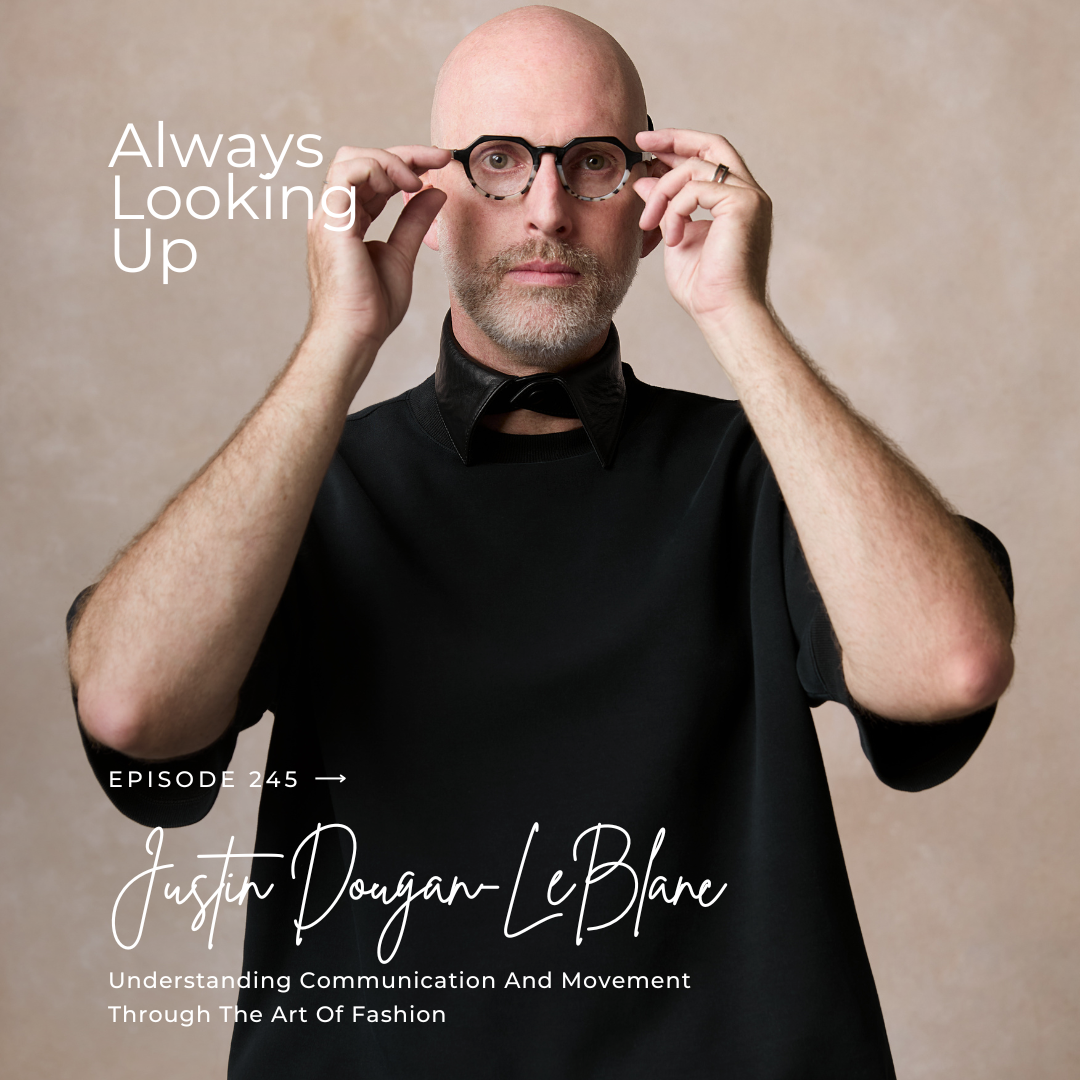
A head shot of Justin, a Deaf man, wearing a black bow tie and black, short sleeved blouse. His hands are holding his glasses on his face. Overlaid, written in white lettering, it says “Always Looking Up, Episode 245 —> Justin Dougan-LeBlanc, Understanding Communication And Movement Through The Art Of Fashion”
Jillian Curwin: Hi everyone. Welcome to Always looking Up the podcast where no one is overlooked and height is only a number, never a limit. Hosted by me, Jillian Curwin. Each week I will be having a conversation about what it is like to live in a world that is not necessarily designed for you.
In this week’s episode, I sat down with Justin Dougan-LeBlanc. Justin is an artist working across sculpture, installation, and wearable forms using sculptural garments and textile-based structures, his work explores how communication, gesture, and spatial environments shape the body and organized movement through space. We discuss fashion, both the industry’s and the art form’s relationship with disabled bodies, his experience on Project Runway, what it means to have his work be included as a part of fashion’s history, and so much more. Let’s get into it.
Jillian Curwin: Hi, Justin.
Justin Dougan-LeBlanc: Hello.
Jillian Curwin: How are you?
Justin Dougan-LeBlanc: I’m doing well. I’m excited to be here for this podcast. So, it’s actually my first one, so I’m looking forward to it.
Jillian Curwin: I am so incredibly honored and so excited to be talking with you, to be having you on the podcast. My younger self, who has watched Project Runway since season one, is like absolutely fangirling right now.
Justin Dougan-LeBlanc: Oh, that’s so sweet. Thank you.
Jillian Curwin: Thank you. And we’re going to get into it, don’t worry. I guess like as, before we get into it, in case anyone in my audience does not know who you are, why don’t you tell them a little bit about yourself?
Justin Dougan-LeBlanc: Definitely. So my name is Justin Dougan-LeBlanc. I’m based in Chicago and I’m an artist, a wearable designer and installation artist. I’m also a professor. I teach at Columbia College Chicago in the School of Fashion at the moment. I lead a BFA program so, teaching the student how to create collection, different design accessibilities, so forth. Let’s see, what else can I talk about myself? Usually I like to talk about myself, but I’m trying to be aware of the timing right now.
Jillian Curwin: You’re fine.
Justin Dougan-LeBlanc: Let’s see. Right now, I mean, I definitely have a long history relating to design so, my background is in architecture, going into fashion and now going into art. So, it’s been an interesting joining about having conversation about accessibility and understanding how to talk about our learning experience and core memory, and just really sharing my experience as a Deaf person.
Jillian Curwin: I don’t think I knew that you started in architecture. That is fascinating to me.
Justin Dougan-LeBlanc: Yeah, it was interesting because I’ve always known I wanted to be in design. Growing up, I was always a maker, so I wanted to figure out what does go with art and math. So those are the two jobs that I like. So the first thing I thought was, like, architecture. Perfect. I measure thing, I would build thing and try to figure out how to provide space for people. But, I graduated the internship and I realized I need to make with my hand. So that was something I had to figure out. Like, what can I do that’s similar to architecture? And that’s when fashion came in. And to me, fashion also has math because you have to measure the body, understand everything, but also work with material. So it’s a really exciting, easy transition for me. I just had to learn how to do different material for that content.
Jillian Curwin: That is so cool, and so true. I kind of had a learning experience over the past few months where, like, I thought I understood what it takes to make a garment...No. There is so much math involved that like I, that blew my mind. And so, we’re going to get into it but, before we do, this is a question I always ask and that is how do you define being Deaf?
Justin Dougan-LeBlanc: So for me, my interpretation for being Deaf is, is a cultural identity. It’s true I am, I was born deaf. I grew up deaf. I had hearing aids, I have cochlear implants and, growing up, I learned total communication. My parents wanted me to make sure we have access to multiple different language. So, and, I learned many methodology and how to communicate. But for me, it’s an opportunity to have a unique perspective on the world because I’m constantly reminded I’m deaf every day, no matter what. So I think for anyone who has different capability, you can feel the same way. But I will... Remind every day. And, I think growing up, of course I always had a challenge trying to figure out how to comprehend what I’m working with because I didn’t have any, any other people to look up to who’s similar to me. So that was a challenge growing up. But right now, I think the opportunity for me to tell a unique perspective, especially in design, because as a Deaf person, I constantly say that anything that we can problem solve.
Jillian Curwin: Yes.
Justin Dougan-LeBlanc: That’s really exciting. So I’m like, what... Can we look at it this way? Because that’s how I see it. And they’ll be like, “Oh, I never thought of that.” I’m like, “Well, I see this every day.” It’s like a constant reminder. It’s like, let’s figure it out and see where we can go from there. So, I think for me, it’s my identity as a Deaf person. Do I see it as a limitation? No. Because I was...I figured out how to navigate with other people and see what I can do. And it’s the identity, again, a cultural identity for me because it really represents who I am as the person.
Jillian Curwin: That is so...There’s something that you said that is so beautiful. And I think it’s so true in that, like, we have to adapt every day as like disabled people. As someone who’s, you know, the world is not designed for us. And so like, we don’t know anything else. And I said this so many times here, and I’ll say it again, like, I think that, that our lived experience does allow us to like, I think as a community, the d/Deaf and disabled community are truly the most innovative people because we have to be to succeed, to thrive, to simply exist in this world. And I think it’s, there’s something beautiful about that. It is like a part of your cultural identity as well, and I don’t think that’s often discussed when we talk about d/Deaf and disabled identity that it is part of. There is a culture to it as well.
Justin Dougan-LeBlanc: Yes, I agree. And oftentimes people think about disability and the first thing they think about is what they can do to fix it.
Jillian Curwin: Yes.
Justin Dougan-LeBlanc: And I’m like no, o, no, no. Don’t fix it. Like, that’s my identity like, I’m proud of it. And I think one of the things that I’ve noticed for the last couple of years, people have told me what is right, what I need to do, how to behave, all of those things. And I’m like, no, that’s how you want to behave. I have my identity. We do different ways. So, I’ve been telling a lot of people right now I’m in the process of unlearning at the moment.
Jillian Curwin: Okay.
Justin Dougan-LeBlanc: So it’s like, taught me like, why is...? Why...? How to be as hearing as possible. All of those things. Am I...? I understand that’s your culture, but it’s not mine.
Jillian Curwin: Right.
Justin Dougan-LeBlanc: I’m still in the process of unlearning what I was taught growing up. So it’s an interesting process right now.
Jillian Curwin: I understand that, and I think like, so often we are told like, in terms of like, when people are telling us to fix certain things it’s, they’re coming from the lens of they don’t have that lived experience. So they don’t actually understand what our not...I don’t want to say problems, but like, difficulties or what our, like, barriers actually are. It’s just what they perceive them to be. And in actuality, you know, a lot of our barriers, our problems, whatever, that do need to be fixed are much more external than they are internal.
Justin Dougan-LeBlanc: I agree.
Jillian Curwin: I want to pivot to a little bit to you... You talked about, in your introduction, about you as a designer so I want to get into it. And you said you started in architecture. Was there a moment, like a defining moment, that made you, or encouraged you, to pivot into fashion?
Justin Dougan-LeBlanc: No. It’s an interesting story for that one. So, when I was training architecture, there was a moment in time where I needed, like, a break. Like, I need to do something different. I’m a lifelong student. I’m always looking for different opportunities to craft or a skill to learn. I’m constantly learning, Jill. And one of those things, back in the day, I was like, well, let me take a try at clothing to see what I can do. And I remember at the time, I did not know how to sew.
Jillian Curwin: Okay.
Justin Dougan-LeBlanc: Really [didn’t] have any interest in fashion. I did play with my sister’s Barbie back in the day. I mean, hey, it’s the opportunity to come and play with them.
Jillian Curwin: Yeah.
Justin Dougan-LeBlanc: Actually, my sister would be like, “Hmmm, that’s why all the Barbie went missing.”
Jillian Curwin: She’s like, “So that’s why they were wearing different clothes than what I had them wearing before.”
Justin Dougan-LeBlanc: So, one of the things I decided to do was to do a competition. So, there was a fashion competition in North Carolina and I was like, why not? I’m going to try it, see what I can create, and go from there. And, as I mentioned earlier, I didn’t know how to sew, so I used my skill in architecture, like laser cutting, 3D printing, all of those things and be like, okay, I’m just going to try and program it and make some garment out of it. And this was back in, oh gosh, it was in 2000... What year was this? 2008.
Jillian Curwin: Okay.
Justin Dougan-LeBlanc: So 2007, 2008. So it’s been almost 20 years ago now. That’s crazy. And I remember during the computation, I created these... The theme was “Seven Deadly Sins”. So I created these plexiglass corsets out of laser cutting, 3D printing, so it was all hard material that’s been applied to the body. And I remember during that competition, one of the judges was William Ivey Long, who is a costume designer in New York. So, he came to North Carolina to judge the show, and I ended up winning the show. And I was like, oh, maybe there is a pathway right there. And I had a small conversation with William Ivey Long, and he was like, “So what kind of career you have in fashion?” And I...? I’m in architecture and...
Jillian Curwin: Like, this is just for fun.
Justin Dougan-LeBlanc: Yeah. Like, hmmm, I think you need to switch career right there. I’m like, okay, let me see what possibility is there in that. And that’s when I started to change my career from architecture to fashion, because I was curious about the possibility in that. I’m always a person who likes to take risks so, and that’s probably why I gave my parents a lot of gray hair.
Jillian Curwin: Yeah.
Justin Dougan-LeBlanc: Was just like, let’s see where it would take me and see what’s possible. So that was my story right there.
Jillian Curwin: I mean, that is so cool. And I will say like, hearing you kind of like describe how your, your early process was, and that you didn’t know how to sew so you kind of used architecture to create fashion. And the,n seeing what you did on Project Runway that... I see it, I get it. That totally tracks. But I also like, I kind of love that. Like, it just kind of like, that you were kind of like, no, this is actually for you. I think that, that’s like, it’s not often that I think like, and it’s or... No, it’s common. I think other people see our potential before we actually see it in ourselves. And so, for in this competition for them to say like, this is your path for you, I think that’s really cool and to know where it led. And I’m curious, and comparing it even to architecture, but also like, as you were entering the fashion design space, like, did you find it to be the art form...? Because I think there’s a difference between the art form and the industry. Like, did you find the art form to be accessible and inclusive?
Justin Dougan-LeBlanc: It’s a progress.
Jillian Curwin: Fair.
Justin Dougan-LeBlanc: Yes. I think that is actually a great question right there because... It’s, it’s one of those questions I’m constantly thinking about is what is my role as a designer and artist and how I can apply it to....? There’s more work that needs to be done in that area, number one, because historically there’s not enough. There’s not enough conversation about accessibility and design or architecture, all of those design in general. There is a number of representation like, for the Deaf community and what The Met is doing right now, which is wonderful. But I’m always thinking like, there has to be more.
Jillian Curwin: Yeah.
Justin Dougan-LeBlanc: Yeah. It’s just like, it’s one question that stumped me, but at the same time, I... It stumped me because I can’t think about other artists at the moment that I can relate to. And that’s just part of like... There’s more work that need, needs to be done in that area.
Jillian Curwin: I agree. And we’re going to talk about The Met and the exhibition later on but, I think what it revealed to me in walking through it was that, and I’m going to ask you about the industry, was like the art form and the industry are on at very different paces. And that, in seeing the art form and in particular, seeing not necessarily the fashion pieces of art, but the pieces that were kind of held within that talked about disability, or the specific disability relating to the mannequin that was perched above... I’m trying to like be... I don’t know how to like, else to describe the exhibition and the setup, but was that the art form at least has seen and been more inclusive of disability than the industry has been. And it’s interesting to, like I... It leaves me with the question like, okay, well, where did...? Where, where did the split happen? Where did, somewhere along the way, that the industry either stopped moving at the same pace or even fell backwards?
Justin Dougan-LeBlanc: Yeah.
Jillian Curwin: And I think that, you know, like, that’s why like, it kind of really like had me separating the two. I think that (moment) like, in taking it all in, in.... like, was where I really was able to realize that there is a separation between fashion as an art form, and design as an art form, and then in the industry as well.
Justin Dougan-LeBlanc: I agree. I agree.
Jillian Curwin: And then, as you were coming in like what, what, what did the industry look like for you? Like, was it accessible? Was it inclusive? Like, what did that look like for you?
Justin Dougan-LeBlanc: So, I think for the industry, I mean, if you speak about fashion or architectural design, there is still a significant barrier. Oftentimes people rely on spoken communication. That’s not my first language. So that’s one thing. I’m trying to accommodate those people who need communication to be able to talk about the design, the concept, any innovation that need to happen. And, but oftentimes I never hear about accessibility. So when we talk about fashion, we talk about architecture, accessibility tend to be an afterthought...
Jillian Curwin: Yeah.
Justin Dougan-LeBlanc: And something that I need to change in the industry because I cannot, I can’t, I cannot threaten that... Accessibility is the opportunity for innovation because if you start there and then people realize, oh, there is more clever or more creative solution that could be done that will benefit not those who have disability but, for everyone. That’s one thing I’m teaching my students now at school is I...You have to think about accessibility in design because, to be honest, if you don’t think about that then you’re excluding a large population that could be wearing their designs. Like, let’s think about that first and then become inclusive. So, I’m always like, preaching to them about this. And so it’s something that the industry need to work on and change because again, accessibility cannot be an afterthought.
Jillian Curwin: No. And so often...
Justin Dougan-LeBlanc: It has to be the beginning of the conversation.
Jillian Curwin: Yeah. I was gonna say so often we see it as the afterthought and like, as a community, we can tell when it is versus when it isn’t versus when it is thought about in those initial phases of design. And, it’s interesting or like where my, I think, frustration for this industry that I love, that I always say, or have been saying recently, that doesn’t love me back, is that it is an industry that champions innovation constantly, that demands it actually. But yet it still is very... It’s still like, it’s very rigid and like, will not accept innovation in regards to accessibility.
Justin Dougan-LeBlanc: I agree.
Jillian Curwin: Like, in that first step of accessibility, that first step would be just to consider it. Like that’s actually, like, that’s just the first step for like, that would be innovation if we see the industry as a whole really consider accessibility from the groundwork. And like, that would be just the first step. And it’s not even willing to do that much.
Justin Dougan-LeBlanc: Yeah, I agree with that. And I think the other thing that I’m noticing is really about the reputation and the company. So, for those in leadership role, we need to be able to see, like, the visibility, more visible people in the art. So, we need to constantly see the right people, the right kind of conversation, dialogue, relating to this topic. So, I think that’s the other thing that we have to take notice is: Do we see those type of people who have different kind of disability, or Deaf people, or so forth in leadership? Well, I haven’t. So, I’m hoping that will change in the future very soon because it has to start from the top.
Jillian Curwin: Yeah.
Justin Dougan-LeBlanc: And working your way down.
Jillian Curwin: Yes. Fashion is one of the few industries, I always refer to Miranda Priestly’s speech about the blue sweater in Devil Wears Prada, like that, to me like, encapsulates like how the fashion industry works, where it’s like literally from the top down. It’s one of the few places where like trickle-down actually applies.
Justin Dougan-LeBlanc: I 100% agree with that. And that was a good like key in with that one.
Jillian Curwin: Yes. We love making a Devil Wears Prada reference. Speaking of another form of fashion media, let’s talk about Project Runway, which is one of my favorite shows. I say it was my starting point, not just to Bravo, but also like to the fashion industry at a greater scale versus... compared to just me shopping. What was your intro to Project Runway like, how did you discover it?
Justin Dougan-LeBlanc: To be honest, the story behind Project Runway is I just graduated from grad school, at the time, and I didn’t have a job lined up at the time. So I was like, trying to figure out what can I do. Like, what kind of career can I find? And the, the fun story behind this is my boyfriend, at the time who’s now my husband, his mother found the application for Project Runway and it was due in like, two days. But she sent it to me, and she’s like, you should try out for this. You know, I, I have nothing to lose so, I mean, why not? I don’t have any job lined up or anything yet. So, I went ahead and applied for Project Runway, not thinking much about it, and they call. They call. I’m deaf, first of all...
Jillian Curwin: Yeah.
Justin Dougan-LeBlanc: I got a voicemail that they wanted to interview me for Project Runway. I was like, oh, okay. So, I went and did the interview, that’s where I met Tim Gunn and Mondo for the first time. They did the interview and from there it really happened very quickly like, within a month.
Jillian Curwin: Wow.
Justin Dougan-LeBlanc: I applied to get into the show, so it didn’t give me much time to prepare.
Jillian Curwin: Okay.
Justin Dougan-LeBlanc: It was a really interesting experience. I know, I would love to talk about the experience about accessibility on the show.
Jillian Curwin: Yes. I have several questions about that because, I mean... I think, for me, if I like, looking back at, and this was around like 2013, if I remember correctly, was your season...?
Justin Dougan-LeBlanc: 2012-2013. Yes.
Jillian Curwin: Like, you might have been the first disabled person, person with a disability, that I saw like, on Bravo in that way. Like, and certainly like, in a competition show like this. Like, there had been like, the TLC shows, I know there was a disabled Housewife. I don’t think I was watching that show at the time. I’ve been in and out of my Housewives, I’ll admit. But like, I think for like, it was such a big like, oh! Like, I felt like, big moment for me watching at home, seeing you on the screen. But obviously, you know, we saw that there was an interpreter but I’m curious. What didn’t we see in regards to accessibility? Like, what did they do to make it accessible? And was it accessible?
Justin Dougan-LeBlanc: Yeah, yeah. See how much time we have on this one. I think we... I did the show... I remember when I did the interview for it. At the time, again, this was in 2012 so we had, right. So we had, we are obligated to have a sign language interpreter and so forth, but...
Jillian Curwin: Right.
Justin Dougan-LeBlanc: It wasn’t enforced as much and, a little bit of a more of a backstory. So you mentioned it’s the first time seeing somebody who had a disability on reality TV show. I kinda did a little research on that as well at that time, trying to figure out what other shows have done that in the past. And I can say that the first Deaf person who competed was on Survivor. Her name is Christy. And that was like, in back in the early 2000. And she had no interpreter, no way to communicate with her castmate. So, it was really... I, I’m like shock that they like, left her without any mode of communication. And I remember sitting there, I was a teenager at the time, and I’m, “Is that my life right there?” Like, trying to figure out how to communicate with other people and not knowing what’s happening or understanding the challenge. So, really frustrating to watch that. And then after that, there was Amazing Race and there was Luke Adams with his mother and, fun story for that one. Luke, we went to school together, in elementary school, so we grew up together. So we’re like, real-, reality TV show buddies. But, for Amazing Race, his mother became the interpreter for him.
Jillian Curwin: Okay.
Justin Dougan-LeBlanc: Yeah, some kind of access right there. But, in a way, it’s not like full access, especially when there is a challenge because typically they do challenge separately. So one person have to do it...
Jillian Curwin: Right.
Justin Dougan-LeBlanc: And then the other person will be rooting behind the scene. So again I’m like, where is the accessibility right there? And then we move on to Project Runway. So, and I’m glad that you mentioned interpreter because that was the first time on TV they had an interpreter on the screen. And that was a really significant, significant moment for me because it was really important for me to represent myself as a Deaf person, and to show how I’m getting the information. But, it wasn’t easy at the beginning because, I recall when they did the opening shot and you’re welcome to go back and watch it, season twelve, and see what I saw. We had a first challenge, we had to go to an airport where a parachute coming down, and that’s also where we saw Heidi and Tim Gunn for the first time presenting our first challenge. If you look at the group, and I was one of them, you see all of them is looking at Tim and Heidi. You’ll see me looking the other way.
Jillian Curwin: Okay.
Justin Dougan-LeBlanc: They did not include the interpreter in the shot.
Jillian Curwin: Yes.
Justin Dougan-LeBlanc: They put her behind the camera. So, my accessibility and I was like, again, this was my first time, never been on camera or anything, I’m trying to navigate what’s happening, but I’m also trying to educate them about accessibility. So, I should be designing, but I’m also teaching at the same time. So, it was a lot. And I remember, during the first challenge, I was like, I need to talk to the producer because this is not working. Like, I can’t. And I remember, maybe challenge two, was still trying to figure it out. And for example, when Heidi come on the runway and say, “One day and one day you’re out,”
Jillian Curwin: Yeah.
Justin Dougan-LeBlanc: My interpreter will be somewhere else. Like I... And the production realize that it’s a bad look when you have one designer who’s looking the other way and everybody else is looking that way. And sometimes they will tell me to look at Heidi and I’m like, no, I need to look at my interpreter so I don’t miss anything.
Jillian Curwin: Right.
Justin Dougan-LeBlanc: They’re starting to like, click like, oh. Oh. Okay. We need to have the interpreter next to whoever is speaking. I mean, so I can get the full information from them. And I think it was like, episode three, if I remember correctly, they finally, had my interpreter come in screen, standing next to Heidi when she announced the challenge. Finally. It took three episodes to figure that out. So I was trying to survive, get through the next one...
Jillian Curwin: Right.
Justin Dougan-LeBlanc: ... Is like, oh, okay, I need to put her next to the speaker. So, from that point on, they always have the interpreter next to Heidi, or Tim Gunn, or whoever is speaking. It was really exciting when I saw it on TV because, like, finally now people can understand what I need like, why I need to make sure that I have access to information. And, to be clear, all Deaf people have different needs like, we have a spectrum of need. For me, I prefer to sign. I want to be able to understand people and then have interpreter so I’m making sure I don’t miss any information. So that’s my need. But again, for the Deaf population, they all have different needs. Like, some of them don’t need interpreter, some of them do. And it was, I can go on and on with it, but it was like one of those moment in history like, finally. Okay. We need to really represent how I interact with the interpreter, how I get information for the challenge and all of those things. So, but it was a challenge like...
Jillian Curwin: Yeah.
Justin Dougan-LeBlanc: You know, if I look back and be like, oh, I wish I was more aggressive at the time, making sure I get my, get access to the information, and making sure the interpreter was there. It was challenging. So just competing and teaching.
Jillian Curwin: Right. Like, you’re there to compete. Right. You’re there to compete. And then, and I think this is common for a lot of us, we, in whatever space we’re in when, whether it’s our place of work or really any space we take up, it’s like we recognize that we have this additional... Not burden, but like, not even like, I don’t know what the right word for it is, but we recognize that like, oftentimes we will be asked to do more just to have our basic access needs met. And for you in the competition like, that’s like you’re trying to focus on the challenge, on like, understanding what you have to do, the rules of it, etc.. And it shouldn’t have had to been on you to try to make sure that you were... your access needs were being met, that your interpreter was there, or that the shot was looked okay. Basically like, that shouldn’t have been on you. Like, that is something that they should have figured out. And I don’t think like, now I’m like, I want to like, look back and like, see, because I do... I don’t think, from my recollection of watching the season, and I’ve watched it many times as well as every other episode of Project Runway, I’m not ashamed to admit it like, there were definitely shots where like, seeing with you and they’re like that... the interpreter wasn’t seen, at least to us. So it’s like the assumption though, that, that she was there for you always, I think, was kind of assumed, but that’s still frustrating that... She should have always been visible when...
Justin Dougan-LeBlanc: I agree with that. And, I mean, I think that was, again, at the time the production team were learning at the same time, trying to figure out how to navigate with the interpreter. And I think, also, go back to... I think having a sort-of support. So, the interpreter is somebody I worked with for decades. So, it’s somebody that I knew already, that we have a good working relationship, and, but I think the production team was always concerned that they would be feeding information to me and I’m like, that’s not professional.
Jillian Curwin: Right.
Justin Dougan-LeBlanc: They’re trying to limit my interaction with the interpreter, which is understandable. But, at the same time, I think one of the things that I wish I spoke up was I wanted the interpreter to be in the room where we’re making at all times, because that’s where all the gossip happened.
Jillian Curwin: That was going to be my question because I think that’s what...when I say like, I didn’t realize that she wasn’t, or, like I assumed that she was there. It’s in those scenes where you’re not having the conversation with Tim Gunn or you’re not at, at the judging was like, was she just there? Like, were you able to be a part of the workroom conversations that I think a lot of us love watching from home.
Justin Dougan-LeBlanc: Yeah.
Jillian Curwin: That’s frustrating to me.
Justin Dougan-LeBlanc: Yeah, it’s just like, I’ve never been able to develop a work relationship with the designer until the very end, when the group became small and that became easier. But at the beginning, when you have like 15 or 16 people, that’s challenging. I struggle with two people now. So it’s like, trying to understand what’s going on. And, I mean, of course, I’m always aware of the louder personality for the season, because I think... One of the things that I was so happy that the camera crew caught this moment, there was like a little argument and the sewing lab, and I would in there during that time, and I could hear them over, behind me. And I’m like... I have no interest in drama, first of all. Like, I don’t have time for that. Whatever. Get out of way. I don’t want to be part of that. But it was like one of those moments like, oh, I’m so happy I’m deaf.
Jillian Curwin: You just tune it out.
Justin Dougan-LeBlanc: [I don’t have to] listen to them. I’m fine. I don’t need that.
Jillian Curwin: Did the contestants, did the judges, or did anybody like, working in production, make an effort to, to communicate or to learn to communicate with you in a way that was more accessible for you?
Justin Dougan-LeBlanc: I think at the time, and their perception, yes.
Jillian Curwin: Okay.
Justin Dougan-LeBlanc: If it’s what I needed? No.
Jillian Curwin: Gotcha.
Justin Dougan-LeBlanc: I would say it’s almost like a dance, in a way. I have to be nice, because I want to still compete in the show. I, I want to be on their good side and to keep going with the show and try to figure things out. I will say that post-Project Runway, I still keep in touch with the production crew from Project Runway: All Star because they took i more additional consideration. Now we did Project Runway, the first one, and then I did All Stars, though they were more considerate at that time.
Jillian Curwin: Okay.
Justin Dougan-LeBlanc: So it was the progress. Like it’s, it’s not perfect, but the learning is getting better and we’re still working on getting there.
Jillian Curwin: Okay.
Justin Dougan-LeBlanc: Yeah. So it’s always the progress. I mean, yeah.
Jillian Curwin: That’s... I think that’s, like expected. I think like, it’s like kind of understandable, just kind of given the current just like, and even then at the time, like kind of where people are and like, again, like, unfortunately, we have to have that understanding, of kind of that, and that understanding that we’re going to have to constantly, with our own access needs or their own disability, have to meet other people with their understanding and with where they are.So yeah...I think.
Justin Dougan-LeBlanc: I was young. I was only like, 23 or 24 at that time. So I was just like, I’m just trying to make it like...So it’s just that mindset at that time. If it happened right now would be completely different. Completely. But it was again, that was 20 years ago. So was it 20...10? 15?
Jillian Curwin: 15? 15 years, I think.
Justin Dougan-LeBlanc: 13?
Jillian Curwin: 13? I can’t do math.
Justin Dougan-LeBlanc: Yeah. More than a decade ago now.
Jillian Curwin: Wow.
Jillian Curwin: And it feels like, in some ways, I feel like I... remember like, exactly where I was watching your season.
Justin Dougan-LeBlanc: The show keep getting added to Hulu or Netflix or something. It’s like, I get messages every day. I’m like, this show was like over a decade ago, but people are still watching it for the first time. It’s like, oh my gosh.
Jillian Curwin: Which I do love. Like, the fashion girly in me loves that people are discovering it for the first time. Looking back and I’ll include All Stars in this as well, but like, did you have a favorite design that you made or even like a favorite challenge that you were a part of?
Justin Dougan-LeBlanc: So naturally I like doing the unconventional challenge because of my architecture background. So, using material that is not normal to the fashion industry. So that’s something that I’ve always been gravitated to. But if I had to pick my favorite challenge, it has to be my final collection for New York Fashion Week because there were a couple significant moments for that one. It is, it was the first collection that, I felt, truly my design and the story that I’m trying to convey. Because one of the things that people need to know is I’m a storyteller first, before everything else. So, one of the things I tried to convey is understanding different core memory as a Deaf person, and how to translate that into design. So that collection was actually, probably the first time I felt like I was able to try to translate what’s my story into a collection. And I’m, I’m so proud of that collection. It was also the first time seeing 3D printing on TV, which is really exciting because during 2012, 2013, and... 3D printing is common in architecture, but not typically in fashion. So I was happy to I was able to like, architecture and merge it with fashion now, and using 3D printing to create these different accessories to really complete the look. And I, I, I would never forget that collection. I actually still have it. My...
Jillian Curwin: Do you?
Justin Dougan-LeBlanc: Some of it. So, they had an auction so people can bid on the collection to buy. it. So the designer, we don’t own the collection. Project Runway do. So we never get any of the clothes back unless you buy it back. And I remember...
Jillian Curwin: I did not know that.
Justin Dougan-LeBlanc: Yeah. My mother did a bidding war with multiple of these garments, and she was able to... There were ten look, and she was able to acquire 6 or 7 of them.
Jillian Curwin: Okay.
Justin Dougan-LeBlanc: I have them still, including the finale look with the the pipette, the test tube.
Jillian Curwin: Yes, yes, yes. I love that dress
Justin Dougan-LeBlanc: I still have that one. That one, it’s like, packed up in a really nice box right now so it could be preserved. And I think that will always be my, the aha moment for me about what I want to do in the future as a designer, as the artist. And I think that dress kindof foreshadowed what I would be doing now. Because right now I consider myself as a wearable, sculptural artist, and I see that dress as a sculptural piece, not only for the manipulation, but for the sound that is created to create rain because it is one of my favorite sounds. I like going outside, listening to the rain. And I would never forget that moment because I was backstage with Tim Gunn, and I remember when that dress came out on the runway, it was complete silence and you could hear the dress just shhh, shhh, shhh. And I was like...
Jillian Curwin: Wow.
Justin Dougan-LeBlanc: “Is there something happening out there?” And Tim was like, “No, people are just in shock.”
Jillian Curwin: Wow.
Justin Dougan-LeBlanc: It’s a really sweet moment.
Jillian Curwin: That is beautiful. I remember when that dress came down like, watching it, and I was just immediately obsessed. And I don’t think, myself at the time, first understood the technology, like the 3D printing, and like that... It was so new and like, what you were creating with that. But then like, just and I don’t think I fully recognized it then in the way that I do now of like, in terms of being a disabled person watching you. And I’m curious if you ever were ever made to, or felt this, along your journey in the show and even after the show was coming out of like, being seen in the industry. Even though, like, I’m just watching at home like, I am just watching at home, forever on the couch watching it and like, but there’s something so like that i just remember feeling like, so seen by the work that you did and like just watching your journey throughout the show. I laughed with you, I cried with you. I cried a lot with you. Like, and I think like, you know, like, I don’t think I, I don’t, I wish I understood like, fully remember, like, or grasp it then, but like, looking back at it now like, it really was such a moment in, for us, especially in fashion, because it’s still a space we’re not necessarily invited into. And like, this is Fashion Week, where you’re showing a collection, and you’re showing a dress like this, and you’re telling your story in an industry that does not often allow us to do that.
Justin Dougan-LeBlanc: Yeah, no, thank you for sharing that, I appreciate that.
Jillian Curwin: You’re welcome. Like, did you...? Like, what was the reaction from the Deaf community, from the disabled community, watching you on Project Runway?
Justin Dougan-LeBlanc: No, I think what’s interesting about the reaction from the Deaf community is... I don’t think Project Runway was very accessible to the Deaf community in the first place. That’s the one thing I notice. Because I get a lot of reaction from able-bodied people. And it was almost like a, a sympathy point, in a way? And that was an interesting perspective. Like, at the time, I was still figuring out what to do on Project Runway, how I interact with other people with whole different experience. But looking back, I’m like, oh. I think the reaction from the Deaf community was mixed.
Jillian Curwin: Okay.
Justin Dougan-LeBlanc: Because one other thing I notice is, yes, as I mentioned, in the Deaf community, there is a spectrum. So there’s different people that have different needs, different access and so forth. And I recognize that I can speak in some way. So, and what I noticed from the show is the editing has made me become a very able-bodied person because I can’t recall a moment where they show me doing sign language on the show.
Jillian Curwin: I can’t either, now that I think about it. I can’t either. I think I can only recall seeing your interpreter doing sign language.
Justin Dougan-LeBlanc: That’s one thing I’m like, I wish I was doing sign the whole time. It’s like I’m doing right now and speaking, but I’m still signing, so I’m kind of becoming bilingual. But at this time, I would do sign for the confession and then I’ll speak. I never really did it together. And I wish I did it together because it would not give them a choice on which one to edit into. So, that was the interesting moment on the show, a realization. I’m like oh, they’re not really showing the full Deaf person I am. This is showing what is beneficial for them.
Jillian Curwin: Right.
Justin Dougan-LeBlanc: So my, so I think the reaction from the Deaf community is mixed for that reason. So, and the reason why I say that is, I will say the con, but I’ll go into the positive. I think for the... Is the assumption that I am a example of a Deaf person who got this. If that makes sense.
Jillian Curwin: Yeah.
Justin Dougan-LeBlanc: No, no, I, I’m Deaf. I was born Deaf. And I oftentimes hear from people who say you’re not Deaf enough. I’m like, oh, okay. Interesting dialogue. And again, that was back in 2012. And it was during the time where they had many different debates related to hearing aids, to cochlear implant, because I grew up with hearing aid, and I did get cochlear implants with 18. It was my choice because, again, I still consider myself as a Deaf person. The cochlear implant is a part, but it does not define who I am. So, it was an interesting moment in time where we’re trying to figure out how to navigate through that and what is Deafness. There’s different interpretations, different meanings for that. Am I doing it right? Am I doing it wrong? I don’t know, but it’s my story. So I’m going to try to navigate through that. So that was the interesting experience during that time. I think right now, with more access, and keep in mind this was before Instagram, TikTok, everything. I had Twitter at the time, I did a lot of posting, but I didn’t have Instagram.
Jillian Curwin: Yeah.
Justin Dougan-LeBlanc: By that time period where social media started shifting. And I think the pro for me relating to the Deaf community is becoming a visible person in the society who’s working in the industry, in fashion and the art, and being able to meet young Deaf people. I’ve been to multiple high school, middle school, elementary school, I’ve been to camp for the Deaf, and just been able to be present for them, to be able to see, Oh! A Deaf person could be successful. And I’m like, “Of course you can.” And I think it goes back to, even with my perspective growing up as a Deaf person, I will never forget in high school, I remember, this when I was a freshman, but the Deaf people who know, they know what this means. So I’m going to let them figure it out.
Jillian Curwin: Okay.
Justin Dougan-LeBlanc: I just realized that it’s not a commonplace sign language.
Jillian Curwin: Got it.
Justin Dougan-LeBlanc: I remember I was in high school and I was in the class and I was talking about what I want to do when I graduate. I wanted to go to college, I want to get a degree, have a job, maybe work in architecture, all of those things. And I remember one of the teacher approached me and said, “That’s not possible. You’re deaf. The best you can do is graduate high school and find a job. And I was like...
Jillian Curwin: That’s rude.
Justin Dougan-LeBlanc: I’m somebody... And this person knew sign language. So she signed that to me. I was like, oh, so she’s defining what I should be doing.
Jillian Curwin: Right.
Justin Dougan-LeBlanc: That’s not right. So, of course, I share with my mother, who happened to be a lawyer, and she was like no, it’s not going to happen. So she went to the school board and everything, and it became a whole big thing. But it was just that moment it’s like, “Oh, I’m not good enough. I’m not value.” So it was the moment in time I’m like, okay. But I didn’t let that define me at the time. And I’m thankful for all the support that I’ve had growing up and just been able to fight for my right. So, looking back to that, it’s important for me to meet those young, Deaf people so they can see what they can do. And that’s something I will always keep doing. Like, I want to be public facing person, to be able to tell people like, you can do whatever you want to do, just put your mind to it, and fight for it, and you will get there. So it’s a work in progress, and I want to be there for them. I want to be there for the Deaf community. I would never abandon them. I would never do that.
Jillian Curwin: Yeah.
Justin Dougan-LeBlanc: It’s a part of my life and I will fight for them.
Jillian Curwin: I love that. That is so incredibly powerful and beautiful at the same time. And I think, you know, and kind of like then has me wondering like, who then from 13 years ago to now, like, how has the show changed you? But also like, how have you grown as a designer? Like, who are you now, Justin as a designer, as an artist, now?
Justin Dougan-LeBlanc: I think that’s a great question because again, I love exploring, trying different, trying different things and see what’s possible. And the one thing you have to know about my work... I just realized, okay, it’s back now.
Jillian Curwin: Zoom needs to stop doing this. There we go.
Justin Dougan-LeBlanc: It goes up. I don’t know why. Zoom... Come on, Zoom. Make it more Deaf friendly, please.
Jillian Curwin: Right.
Justin Dougan-LeBlanc: I think right now I consider myself as a wearable, sculptural artist, installation artist. And it’s been moving more into the contemporary art world at the moment. And the shift happened from fashion design to more contemporary art. Having that conversation occur when I realized that my story has value. So I don’t necessarily have to make things for commercial purpose. So I can make clothing for commercial so people can wear it, buy it, and then discard it and go on. But I wanted to kind of shift it into a more of a conversation purpose. So, how can we do design? How can we make art more accessible? And that became my topic that I’ve been interested in and something I’ve been exploring. And this is fairly new for the last six years in this area. And I more and more started to realize the significance of that because, relating to the work and Deaf storytelling and documentation, preserving history, I’m recognizing the importance in that area. Because, so often for Deaf artists, Deaf Language in general, or anything that’s related, is disappearing. And the most recent example that I can give you, I’ve been doing a research at Martha’s Vineyard Island because, if you think about the history of ASL, American Sign Language, it’s an immersive language from French and Parisian Sign Language and Martha’s Vineyard Sign Language. So, the Vineyard has a large Deaf population for a long time. In the last two... I have to do a little history check right there. I’m going blank right now. They have a community of Deaf population where they create a sign language because it was the island, they were removed from the general population. So they had to learn sign language for a long time, from the 1800 to the early 1900s, during that time. But what’s interesting about that, it became one of the reference for American Sign Language. American Sign language. But the documentation for that language, when I did the research at Martha’s Vineyard, it’s gone. And the last person who knew that language was passed away in the 1950s. 75 years ago.
Jillian Curwin: Right.
Justin Dougan-LeBlanc: And there’s no documentation. So it’s like, oh, that language is extinct already. And that, to me, is like, okay, I understand. I know that was a long-winded answer, but I’m understanding my role right now: focusing on Deaf culture and how I can do that through art as the documentation, and been able to preserve history. So, preserving works now, also researching what we had in the past and trying to preserve those as well. So, I see myself shifting into like, a cultural preservation artist. I don’t know if there’s a word for that. I’m just making it up right now. It’s important we have to preserve those history right now.
Jillian Curwin: Absolutely.
Justin Dougan-LeBlanc: ...to our history.
Jillian Curwin: Absolutely. Especially, it feels like we’re at a time right now where there are a lot of forces trying to erase our history, or not wanting us to know our history. And like, I did not know the relationship to Martha’s Vineyard and how that community there influenced what became, what is now ASL. I did not know that.
Justin Dougan-LeBlanc: And I didn’t either. And I’m like, oh, okay. So, this is important information.
Jillian Curwin: Yeah. Absolutely. And I’m curious, like, is there, is there a Deaf fashion history? Like, does that exist?
Justin Dougan-LeBlanc: No.
Jillian Curwin: Okay.
Justin Dougan-LeBlanc: I would say it depends on what content you’re talking about. So, Deaf fashion, from a medical standpoint, sure. I mean, we can talk about hearing device like, different accessory that we had to wear a hearing aid, microphone, or... We can consider those to be fashion. I don’t think so because I hated wearing them when I was a kid. But it’s a yes and no answer. So I think it’s yes from a medical standpoint, because it’s the opportunity for people who want to fix deafness. So, of course there’s a lot of information about how to repair, how to provide that resource and different things. Even for cochlear implant, the shifting, the design and the aesthetic of that, I consider that to be fashion because yes, it’s a medical device, but they are also thinking about the appearance too. So, anything related to appearance that’s fashion. So...
Jillian Curwin: Yeah.
Justin Dougan-LeBlanc: And, but I think the other part is relating to Deaf culture, relating to Deaf storytelling, storytelling. I don’t think there is enough documentation for that yet. And that’s where I come in.
Jillian Curwin: Okay.
Justin Dougan-LeBlanc: No interest in designing medical, or developing different products for that. And I want to know what is the core memory, the experience growing up. What did they encounter? Like, what were the barrier they... or they overcome like, those kind of stories I’m interested in. And I’m also realizing my story is significant too. So am I...
Jillian Curwin: Absolutely.
Justin Dougan-LeBlanc: I’m documenting all of those things, all of those things through my work. And... But it needs to be more of that conversation because one of the things that I focus on right now, as an artist, is I don’t focus on Deafness.
Jillian Curwin: Okay.
Justin Dougan-LeBlanc: I get inspiration from being a Deaf person. Yes. But I focus on the, the tension that we see in the society with communication, the expectation, the thing that we have to conform into. So those things, that feeling that you get, that frustration and trying to communicate the, the anger that we feel... I need to capture those little things and really allow people to understand how we feel, as a society like, what is society doing to us? Right? I’m going to show it to you.
Jillian Curwin: Right.
Justin Dougan-LeBlanc: My art like...
Jillian Curwin: Yeah.
Justin Dougan-LeBlanc: What are you doing, And it’s almost like a mirror to them as well.
Jillian Curwin: Exactly.
Justin Dougan-LeBlanc: Oh. Okay. And those are relevant. Those are something that need to be spoke about like, the communication...
Jillian Curwin: Absolutely.
Justin Dougan-LeBlanc: The conflict, all of those things. And I mean. Yeah.
Jillian Curwin: Yeah.
Justin Dougan-LeBlanc: Yeah.
Jillian Curwin: Yeah. And it’s interesting that you...
Justin Dougan-LeBlanc: ...I got really passionate there.
Jillian Curwin: Yeah, no, I love it. And no, it’s interesting because I didn’t think about it in this context, but you’re absolutely right. And I think it might have maybe connected some dots that I didn’t realize weren’t connected in my own head of like, where disability’s relationship with fashion kind of in the industry, not necessarily the art form, but it was when we, when it was included in the industry, it was in the medical context. It was through that medical model and in trying to create fashion, or use fashion as a way to fix where, that’s then not allowing us to be seen fully, if at all still. And I didn’t put that together in my head, but you’re absolutely, absolutely correct about it. And I think again, like it just shows, you know, we’re talking you’re talking about these really, you know, it’s not just about the fabric. It’s not just about the way it’s manipulated, the way that it’s draped, etc. You’re talking about like, the way it’s used to tell stories. And that’s where I think that lends into the argument that fashion is an art form. And like, I think it shows because like it, that our history is told through fashion. Like, it is absolutely... Fashion is used as a device for storytelling, past and present. And that is so important why we need to know it, and we need to understand it, to understand how we’ve gotten here. And it’s frustrating when part of that history is not available, or not accessible to us. And so we have to continue to fight for its preservation, to fight for our own preservation, like in preserving our history, we’re preserving our own place in this, in like, in the present, if that makes sense.
Justin Dougan-LeBlanc: It does. Yeah. 100%. And, again, this is... Our time is now. We’re not going away. So, it’s just, we need to advocate ourselves and advocate other people to be able to inform what they need to do and how our I... I’m going blank right now. But it’s such a significant topic right there.
Jillian Curwin: I....I think what this really means is you’re going to have to come back on the podcast. So we’re going to have to like, have a whole other, separate conversation about it, because I think there’s so much to unpack and reveal through that, because I think there’s so much more to it than just kind of what we’ve like... I feel like we’ve just skimmed the surface, honestly. And so like, that’s just really my invitation for you to come back. You were going to get one anyway, but like, this is now me formally extending it to you. But I do think that this conversation does lead to where I want to go next in terms of like, preservation and history and the art form of fashion, which is The Met, The Metropolitan Museum of Art, which does its, which tries and does its job in, ummm, in telling fashion history. And, you now have, you have pieces, you have clothing in it. So we need to talk about it. How...? Yeah, I guess...
Justin Dougan-LeBlanc: So weird, to be honest, to be part of The Met at the moment and be one of the artists, one of the designers represented. And I think what The Met has done is significant in my eye, because the opportunity for us to have a place at the table.
Jillian Curwin: Yeah.
Justin Dougan-LeBlanc: And I think one thing I will do is do a shout out to Tilting The Lens, She taught me the sign for that one, Tilting The Lens, and Sinéad who was one of the advisor for the exhibition. And that’s where I met you, as well.
Jillian Curwin: Yes, that’s where we met.
Justin Dougan-LeBlanc: It was really a delight to meet all of you. And, I think what The Met did is interesting because they started having the conversation about the art, using the body as art. So, and that is something that I do because, you mentioned earlier in the question, what am I doing now? So, I say wearable sculpture and use body as one of the medium. I don’t look at body as something to dress anymore. It’s part of a medium.
Jillian Curwin: Okay.
Justin Dougan-LeBlanc: So, I’m using the shape of a body, or the form, or how it moves around the space. That’s part of the art now. So, it’s not somebody that’s just put it on. And, going back to The Met, I think how they presented the project, I really appreciate that it was not medical focus.
Jillian Curwin: Yeah.
Justin Dougan-LeBlanc: That’s the one thing that I really appreciated because oftentimes, too many times I’ve seen in different exhibition or gallery is more medical reference. And I... Not really what I’m doing right now. And I was really happy to see how The Met figure out a way to represent the different able-bodied people. But, as an artist, as an innovator, as a... changing the world by changing the equation. And I find that to be really exciting to see that the exhibition. And, again, it’s just an honor to be part of it and that they consider my work to be part of the exhibition. And yeah, I’m thrilled. It’s only been a month since it opened, and it still doesn’t feel real.
Jillian Curwin: I was gonna...? Has it sunk in that like, your, your work is in The Met?
Justin Dougan-LeBlanc: I don’t think it will ever feel real. But I think what’s important for me is that it’s now part of history.
Jillian Curwin: Yeah.
Justin Dougan-LeBlanc: And that’s something that I’m starting to realize now is that it’s become part of a much larger story right now, and it’s something that will live on after I die. And it, and that’s important to me because it goes back to documentation, like Martha’s Vineyard like, that is gone. So I, now I know The Met has my work that will live on, and that gives me some motivation and relief at the same time that... Okay. They have some piece of a Deaf history right there. Finally. And I’m thankful for that, and thankful they consider me for that opportunity. So, they now have a piece of the Deaf history there. So, at that part I’m like, that’s really special.
Jillian Curwin: Yeah. Absolutely. And I think for me, like what I loved about the exhibition... First, what I loved about that day was that, and I don’t know if this was like, I don’t think it was intentional, but it just kind of like magically happened that all the people with disabilities gathered together, like, and we shared that space and really were taking it all in together and kind of, in celebration because it was...The exhibition itself was a big moment in the sense that like, this was... We were being put, brought into this space, which is kind of put on a pedestal in the fashion industry, The Met Costume Exhibition. And we, you know, for the longest time, it’s been a space where, if we are included it’s like as one, we’re like one... we’re just like the exception to kind of say, oh, look, we’re being inclusive, but like, it’s not, we’re not given the same treatment or, so to speak, or we’re not, there’s only one where it’s like where the token is... more or less. And here it’s like, no, we’re showing off not just the disabled body, because they had the section of mannequins that were disabled bodies, but then also those disabled bodies that are, not even invisible in the sense the disabilities are invisible, but like, that they’re the designers. That they’re the actual, that they actually are the creators which, with the exception of Project Runway, more or less like, we don’t really get to see, or we haven’t seen really in the industry, have been given that opportunity to see. And so, there was something really powerful about that. And then, and I talked about this in a previous episode, I know when talking about the exhibition with the mirrors on all the mannequins, so that way it forced you to see yourself reflected in not just the disabled bodies, but the work of disabled artists too. And I think that, to me, was like one of the most powerful and effective parts of the exhibition. And like, leaving, I just was wondering, and especially like this was before, you know, the gala that night and like, before it opened of like wondering, you know, knowing that the industry is coming in and that this is going to be open to the public and like, what are they going to take from it? Are they going to see what we saw? Are they going to...? Is it, is it going to create any sort of change?
Justin Dougan-LeBlanc: I think that’s a great question, and time will tell.
Jillian Curwin: Yeah.
Justin Dougan-LeBlanc: It’s my hope that this will not be the last exhibition of this kind because, how The Met have created this space for those who have disability, and be able to showcase their talents and, those people who should be in the industry already...I Have a lot of hope. I mean, it’s The Met.
Jillian Curwin: Yeah.
Justin Dougan-LeBlanc: First of all.
Jillian Curwin: Right.
Justin Dougan-LeBlanc: So, I think it’s something I’m like, I have hope that it will not only open doors for those who are in the exhibition, but also for those who haven’t had the opportunity to be part of that, but an opportunity for them to be seen. Because, in a way, it kind of validate the artist, the designer, who’s doing the exhibition, right? Their work matter. So when people see the space and see the work and see something, I’ve already had Deaf people contacting me after seeing my work at The Met, and they’re like, I can’t believe they have a Deaf artist in there. I’m like, yeah.
Jillian Curwin: Right.
Justin Dougan-LeBlanc: I was like, oh, so if they validate this person, then maybe I’m validated too. So it’s kind of, it’s really important. And, I’m excited to see what the next several months will bring. Because one of the things I will be active in is making sure I’m there when they bring the Deaf school to The Met, because I want them to see they’re the Deaf artists right there, and I want to be present for them.
Jillian Curwin: Exactly.
Justin Dougan-LeBlanc: So, that’s what I’m working on right now and... But, relating to the future like, what it will bring, I have no idea. Like...
Jillian Curwin: Yeah.
Justin Dougan-LeBlanc: I know one thing for sure is I’m going to keep working my ass off, right? That’s not going to change. I’m going to keep working. I do have a.. Actually, I will share. I will have a solo show this September at Gallaudet University, which is the the only Deaf college in the world.
Jillian Curwin: Yeah.
Justin Dougan-LeBlanc: In D.C. And I’m actually really excited about that opportunity because it changed the mindset of the space for the gallery. Because oftentimes I’m showcasing work for the general able-bodied population, but I’m having an exhibition for a very unique Deaf population. So, and that will become the extension from The Met. So you see, at The Met, is more of a wearable garment, wearable, sculptural work. So, the one at Gallaudet, it could be focused on sculptural installation work. And that will be opening up in September. I’m really excited about that one. And, so, it’s just continuing the conversation and making sure there is space for us.
Jillian Curwin: Yeah.
Justin Dougan-LeBlanc: Because oftentimes people say our community is very exclusive. So, and it’s something that I’m very aware of. And I’m hoping that, with the exhibition at The Met, at The Met, will give us the opportunity to have a space to talk about this. It doesn’t have to be about disability. It can be...
Jillian Curwin: No.
Justin Dougan-LeBlanc: Interpretation. Like, there’s no reason to pigeonhole us in disability art, disability, wearable fashion, etc.. No. We have, we have things to say that is much larger than the community right now. So,and I’m hoping this would be a good starting point.
Jillian Curwin: Me too, I think... Well, first it’s... First I want to say that’s so exciting. And I’m looking forward to seeing what it is you create, and that is just absolutely amazing. But yeah, I think for me, you know, like, I talked about earlier in our conversation of like, we’re like, the exhibition was kind of the realization like that the art form has always kind of seen us and has, more or less, has always said that we matter, to use what you said earlier, or use your phrasing that you said earlier, and the industry certainly hasn’t. It’s made effort. I’ll give it that. I think that’s me being a little generous to try and say that. But I think the exhibition, hopefully like, just, and I think it’s like more so like knowing who came in after we left to see it, that day, and who’s seen it, who’s come through in the days and weeks and we’re, where, I think about a month after or so after, is understand... Is like, the industry. It’s not even just saying that, like seeing that we matter, because I think they still need to see that. But it’s like, oh, we actually like, there is no more excuses as to why we actually can’t include them. Because again, the art form always has in one way or the other. And I think, you know, as we’re getting a new season of Project Runway, as we’re going into Couture Week next month as, as of this recording, and Fashion Week is always just around the corner. It feels like there’s always a Fashion Week coming up. Like, I want, you know, I’m hopeful, and maybe I’m too hopeful, but it’s also like, again, like it’s this desire of like wanting this industry that I love to finally love me back. And, again, I think the exhibition show that the art form has, in a way, and it’s just like waiting for the industry to, to catch up. And so like, that’s like where I’m like...
Justin Dougan-LeBlanc: I think that’s an excellent point right there. And I think that’s one of the reasons why I’m a professor, because one of the things I recognize is that, yes, fashion industry can be very glamorous. So, there’s the expectation, the ideal form and everything.
Jillian Curwin: Right.
Justin Dougan-LeBlanc: Where do they get their information from? So typically magazine, TV, social media, and all of those things. So, for those who want to learn about fashion industry, fashion design, they will go to school to learn how to develop and design and everything. And that’s why I decided to become a professor, because I’m a Deaf professor in fashion design. And when they see me, that I have a disability, they be like, oh, maybe I can design for those kind of people as well. So I’m trying to catch them early on in there.
Jillian Curwin: Yeah.
Justin Dougan-LeBlanc: Okay, you have to start somewhere, start early and then be like...
Jillian Curwin: Absolutely.
Justin Dougan-LeBlanc: Think about those body type and think about what they need. How can we develop different products that could be accessible for more people? And, it’s almost like a light bulb moment.
Jillian Curwin: Yeah.
Justin Dougan-LeBlanc: Like, oh, this is... Because, to be honest, if people truly started doing accessible design at the beginning, it would be incredible. Like, the thing...
Jillian Curwin: 100%.
Justin Dougan-LeBlanc: And different technology that we have right now, and innovation, it’s like... There’s so many things that can be done. And I’ve heard this so many times that the fashion is like a cycle now. So talk about trends. So, like, the 80’s back so bring on the ... And all of that. That’s just one. I hope it doesn’t come back....Trends. So we see all of these trends, and truly, I think the only thing that will break that trend is accessibility.
Jillian Curwin: Agreed.
Justin Dougan-LeBlanc: Like, it’s right there.
Jillian Curwin: Completely agree.
Justin Dougan-LeBlanc: Like, oh ... With my students like, hey, if you want to break that trend, start focusing in that direction.
Jillian Curwin: Yeah.
Justin Dougan-LeBlanc: So many possibilities right there.
Jillian Curwin: I fully agree. And I think, what you said, just speaks to the importance of, not just your work as a professor, but also your work as an artist in the preserving of the history that you talked about before, or wanting to preserve it. Because I think so often we’re, when we have conversations, or at least in my experience, when I’ve had conversations in the design space about designing for, not... more specifically little people bodies, but disabled bodies in general, told it’s not possible or it’s not there. But that’s like, where, again, like the, the exhibition kind of proved that like, no, it’s there. But that’s also why we need to preserve that history, so that we can so that way we, you as an educator, you know, me with the podcast and like the community itself can point to and say, actually, no, it is possible. It’s been done before. Like, that’s what I like, that’s like, I think of it like, to be like, it’s actually has been done before. You just don’t want to learn how to do it. You don’t want to whatever, like, which is again, it’s like, this is an industry that loves, that really like, to thrive, you have to constantly be innovating. And yet, when it comes to accessibility, it will, it won’t... Like, that’s where it will still refuse to.
Justin Dougan-LeBlanc: Yeah, it’s, it’s so mind blowing to think about that. It’s like it’s still happening now.
Jillian Curwin: Yeah.
Justin Dougan-LeBlanc: Yeah. You know, I have to keep reminding people that.
Jillian Curwin: Yeah, I was like, I remember...I think my... Even during the All Star season of Project... Like the, of like, not Project Runway: All Stars. It’s like, the all star season that they had a couple of years ago where, and it was two years after, I think, they finally challenged their designers to design for bodies with disabilities, because it was during the Paralympic... Olympics and Paralympics, where I was saying like, every week I’m like, where are the visibly disabled models? Where, like, it’s, it’s All Star season, it’s season 20, where are they? And I think, what I love about Project Runway, what I’ve kind of tried to use as like, a point in my arguments that I’ll make, is that Project Runway has proven that like, you can do anything within a day with, with, with the skills like, even with unconventional materials, as you said, which I love the unconventional materials challenge. Like give me, give me a whole season full of unconventional materials challenges. Like, it is amazing what I’ve seen you, and all the other designers who’ve come on the show, do within 24 to 48 hours and just a prompt and a budget and fabric. Like, so, for them to say, well, again, like, it’s not possible or we just can’t. And it’s like, no. And it’s like Project Runway has, if anything, proven what is possible. But even there, where it’s also like one of the more visible platforms for fashion, for the fashion industry, and it’s like, even there, we’re still not like, I’m like, you have the, like, they have the power to prove it’s possible and they just, again, don’t want to exercise it. And maybe for the new season, they will. I don’t know, I would love to come back here and say, you know what? They did it.
Justin Dougan-LeBlanc: Yeah. Yeah. I think there’s something I’m hopeful for them because I think at the same time, if you talk about Project Runway, I’m always looking at the cast member. So what, who are they going to be casting? And I mean right now it’s season 22?
Jillian Curwin: 22? 23? Yeah.
Justin Dougan-LeBlanc: Something like that. And I’ve not seen any other disabled person since my season.
Jillian Curwin: No. No, I think in terms of designer, at least in terms of visible or showing disability, like I think you might have been the only contestant.
Justin Dougan-LeBlanc: Yeah.
Jillian Curwin: That’s the show has had.
Justin Dougan-LeBlanc: Like, constantly thinking about. It’s like, when will they have another person? Because I’ve always hoped that I’m not, I think you mentioned this word before, the token.
Jillian Curwin: Yeah.
Justin Dougan-LeBlanc: Check it off, they’ve done it. They won’t do it again. And I’m like, that’s not the reputation of the reality in this world like...
Jillian Curwin: No.
Justin Dougan-LeBlanc: So, we’ll see what will happen in the future, and hopefully they will take some consideration in that area.
Jillian Curwin: I hope so. Like, I want them to because again, like, I still love the show. And like I, again, I love this industry that does not fully love us back. But, at the same time, which is why though I am constantly like, banging on their door and having these conversations because like, I know it’s possible. Like, that’s the thing. Like, I know it’s possible. Do I know how to sew and like do that construction? No. But I’ve seen designers like you, I’ve seen other designers prove and, you know, presently, but also through, like, in the past that it is possible. It’s just getting over that last... I don’t even know. It’s not even like a speedbump. It’s like that last barrier.
Justin Dougan-LeBlanc: Yeah. Yeah. They got time. I mean, for another ten years.
Jillian Curwin: I can’t wait (that long. I mean, I will, but I can’t wait that long. Who do you look up to?
Justin Dougan-LeBlanc: Oh that’s a tough one. I think other than, of course, the people who have supported me along the way, so my family, my husband and I mean... They are somebody that admire because I oftentimes I do have imposter syndrome. And it’s something that I’m always struggling with like, trying to figure out what am I supposed to be doing. So I definitely look up to my family. For people, as a designer and so forth, I mean, I have to say, the people that I need to work for. I need to work for Alexander McQueen in London. So, back in the day, and I think I look up to him for his ability to tell stories. So they’re able to tell stories, things that he had learned, things that he believed in, to agree with, and how he was able to translate that into art. So, that’s something that I always look for, look, look up to, because that’s something I do with mine. I, I’ve tried to figure out my core memory, my story as a Deaf person. Well, how would that be translated into the art? So that’s one way right there. The other person that I, who is also my mentor, his name is Nick Cave. He’s a sound, street artist in Chicago. And what’s fascinating about his work is it’s wearable sculpture, but it’s more sculptural based work. And he interned for him. And I think his work, in a way, is taking what he’s feeling inside and putting it out. And it’s beautiful work that he’s doing right now, and how he translates his work through sculptural, performance, architecture, sound. So, it come in different medium. And, to me, I don’t think art need to be just one medium. It need to be multiple so you can have a more immersive experience. And that’s why I’m focusing on is, I want to capture those feeling, those experience, for other people to feel too. So, it’s all about trying to capture the emotion and the feeling of that. So, those are the two I can think of right now. There are multiple Deaf artists as well. I know this one, Chella Man, who is an emerging artist. I should not say emerging. He is fully established now. And I really appreciate his dialogue with his art and how he translates through film installation. It’s kind of a similar medium, but.... He had a different Deaf upbringing from mine.
Jillian Curwin: Yeah.
Justin Dougan-LeBlanc: And the spectrum of Deafness. So his is different from mine. He had different story to tell. And I find that fascinating because there is no two Deaf people alike. They’re all different. They have a different story they want to tell. So, I really appreciate his work.
Jillian Curwin: I love that, and I agree. I think that there.... First that like, art is not just limited to one medium. And I love when... I love all of various forms of art. I wish I was an artist, I am not.
Justin Dougan-LeBlanc: Everybody could be an artist.
Jillian Curwin: I, I am not. I do not have that ability.
Justin Dougan-LeBlanc: Well, you have the art of communication.
Jillian Curwin: Okay.
Justin Dougan-LeBlanc: Yeah.
Jillian Curwin: I will accept that. Thank you.
Justin Dougan-LeBlanc: ... The question you’re asking is excellent.
Jillian Curwin: Thank you. Thank you. That means a lot. But I also though, like, I think that you highlighted something that is really important in the sense of, again, kind of going back to when we say like there’s, there often will be made space for one. And it’s like, no, because no two experiences are the same, and each of those experiences have the same value and deserve to be told and deserve to be heard and deserve to be seen. And so I say, like, the more... I want to see more. Like, I just want to see, I want to see more. I want to know all the stories. I want to see all the work. Again, this is such an amazing conversation. I’m having you back on because I feel like there’s so much more we have to talk about in terms of fashion and disability history. So, you’re gonna come back on for... We’re going to make that happen. So stay tuned for that. But, in the meantime, where can people follow you, and see what you’re up to?
Justin Dougan-LeBlanc: Oh, how do I do that? So I usually post all of my information on Instagram. So yeah, @jleblanc, J-L-E-B-L-A-N-C, design. And, you can also find me on my website. So it’s JustinDouganLeBlanc.com. And, I’m not social media savvy, so I need to work on that. So,those are the two I can think of right now. So but you can find me on JLeBlancDesign on Instagram.
Jillian Curwin: Okay. And the links to do so will be in the show notes for this episode, wherever you access it, whether it is on Apple Podcasts or Spotify, my Patreon, or in the Substack. So please go follow Justin, go see, go check out what... the work he’s doing because he’s absolutely incredible. And I’m just, thank you so much. My 13, past, year past self is so like, is giddy being able to have this conversation with you. I cannot thank you enough. I am so honored and I truly loved every moment of this conversation. And again, you have to come back on the podcast. I’m making it happen.
Justin Dougan-LeBlanc: Thank you so much, Jillian. I really appreciate it.
Jillian Curwin: You’re most welcome. The final thing I just have to ask of you is for you to remind my listeners that height is just a number, not a limit.
Justin Dougan-LeBlanc: Thank you.
Jillian Curwin: Always Looking Up is hosted by Jillian Curwin and edited and produced by Ben Curwin. Please make sure to rate, review, subscribe, and follow on Spotify so that you never miss an episode. Join us on Patreon for early access to weekly episodes and bonus content! Follow me on Instagram at Jill underscore Ilana and the podcast at alwayslookingup.podcast for updates, and check out my blog, JillianIlana.com. for more insight about what it is like to be a little person in an average height world. Thanks for listening. See you next week.
Join Always Looking Up on Substack: https://jilliancurwin645746.substack.com
Join The Patreon: https://patreon.com/AlwaysLookingUp
Follow Justin: Instagram: @jleblancdesign Website: https://www.justindouganleblanc.com
Follow Me: Instagram: @jill_ilana , @alwayslookingup.podcast TikTok: @jillian_ilana Website: https://www.jillianilana.com Email: alwayslookingup227@gmail.com