Britt Stewart And Daniel Durant On The Power And Beauty Of Language And Dance
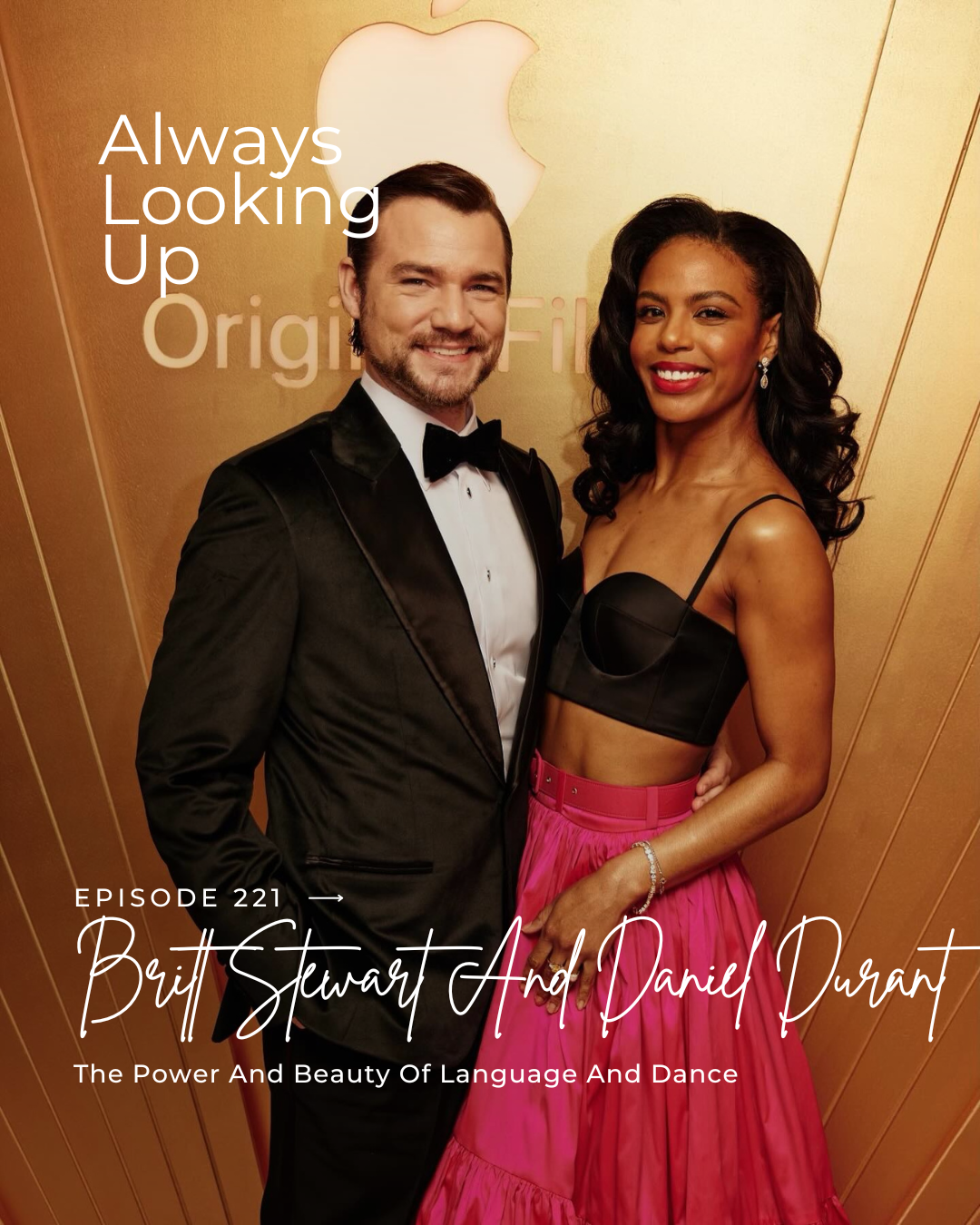
ID: Daniel Durant and Britt Stewart, standing together, smiling, in front of a gold wall with the Apple Logo. Daniel is wearing a black tuxedo and Britt is wearing a black bustier and a hot pink belted skirt. Overlaid, written in white lettering, it says “Always Looking Up, Episode 221 -> Britt Stewart and Daniel Durant, The Power And Beauty Of Language And Dance"
In this episode we were joined by ASL interpreter Justin Maurer.
Jillian: Hi everyone. Welcome to Always Looking Up the podcast where no one is overlooked and height is only a number, never a limit, hosted by me, Jillian Curwin. Each week I'll be having a conversation about what it is like to live in a world that is not necessarily designed for you.
Jillian: In this week's episode, I sat down with Daniel Durant and Britt Stewart. Daniel is a Deaf actor on stage and screen. He is best known for his starring role as Leo Rossi in Coda, a film that garnered three Oscar awards, including the top prize of Best Picture. He also starred in Deaf West's productions of Spring Awakening and Green Day's American Idiot, and made it to the semi-finals of Dancing With The Stars alongside his then partner, now wife Britt Stewart. His ongoing work also includes co-leading acting workshops for deaf students and interpreting in schools, serving as an acting teacher and coach for deaf film camps, as well as national speaking engagements for colleges and universities. Britt is a professional dancer, choreographer and creative leader whose career blends artistry, impact and authenticity in the entertainment industry. Best known as a pro-dancer on Dancing With The Stars, she made history as the first Black female professional dancer on the show and has since made an impact with her presence. She uses her platform to inspire balance, self-growth and connection. As president of nonprofit organization Share the Movement, she champions access, education and representation in dance. We discuss what d/Deaf representation looked like for Daniel growing up and why he decided to become an actor, Britt's dance journey that led her to the dancing with the Stars Ballroom, how they are both working to make their respective spaces in the entertainment industry more inclusive, their relationship and how they made their world and their home more accessible and much, much more. Let's get into it.
Jillian: Hi Britt and Daniel.
Britt: Hi.
Daniel: Hello.
Jillian: How are you?
Daniel: Doing good. We had a nice holiday. A little vacation. And just taking advantage of having time with my sweet wife before she has to leave and get really busy for months on end again.
Britt: Yes. He's right. We've just really been home, enjoying home, with our three kitties before I leave for tour, and this Dancing With The Stars tour will be... Geez, it'll be almost five months, which is crazy.
Jillian: Oh, wow. I didn't realize the tour was that long.
Britt: This is the longest, I think, this is the longest tour in the history of Dancing With The Stars. So it's a blessing because that means that everyone is successful and that the show is continuing. But yeah, it's hard to be to be gone from home for that long.
Jillian: I bet.
Daniel: Well, I agree.
Jillian: Yeah, I bet, and we'll get into the tour and more. But first, in case any of my audience does not know who you are, why don't you both introduce yourself? Tell them a little bit about yourself.
Daniel: My name is Daniel Durant, and I am Deaf. I'm an actor, I've acted in TV and film and also on the theater stage and a little bit of all of the above. And any more about me? I guess that's it for now.
Jillian: Okay.
Speaker4: Yes, I my name is Britt Stewart. Well, that's my professional name now, Britt Durant. And I'm still not used to saying that I know. Yeah. I'm a dancer, choreographer, I guess now I'm a television personality, I guess, whatever that means. And yes, I love representing my community, and, like Daniel, we will stop there for now, because you all will be learning much more about us.
Britt: Okay. And also, I do want to say congratulations. Your wedding look absolutely beautiful. And, you know, congratulations.
Britt: Thank you.
Daniel: Thank you.
Jillian: My first question is for Daniel, and this is a similar question that I ask all my guests, or it's a version of a question that I ask all my guests here. And that is how do you define being deaf? And also do you identify as being disabled? Because I know not everybody in the community does.
Daniel: I identify as capital "D" Deaf. And the reason for that being, you know, Deaf people have such a broad spectrum. You know, some folks can hear a bit, some deaf people can use their voices, some deaf people may not sign. There's such a broad spectrum. And me calling myself capital "D" Deaf, it means I'm proudly Deaf and I'm very strongly connected to the Deaf community, our culture, and our beautiful sign language. And also, there's been a discussion, you know, as far as labeling Deaf folks, or labeling myself, as disabled, I don't feel personally as if I am disabled, but I understand why the outside world can perceive me as disabled because of my diagnosis of being deaf and, and of hearing loss. So it's really interesting that, you know, I don't have a visible disability being deaf. Being deaf is an invisible disability and then communication is where the barrier might happen as far as having to write something down or text, and then someone who's hearing would be able to see that I'm deaf. But if I was just walking down the street, you would never be able to tell I was deaf. So I guess that's where I stand.
Jillian: That's really interesting. And I think for me, it's kind of a little bit of the opposite. Whereas I, for the longest time, didn't necessarily grow up identifying as disabled as a little person, but society kind of saw me in a way. And it's not even that necessarily they saw me as disabled, but saw that I was different and didn't understand necessarily what that difference was or what that meant, and didn't know if I fit into the box of disability because I think society has a has a box of what they consider to be disabled, and it's hard for them to think outside the box and to be more inclusive and understanding of what disability is and what it looks like and what it could be.
Daniel: I completely agree, and I understand with what you're saying.
Jillian: What do you...Oh, go ahead.
Daniel: It's interesting when folks who don't know anything about being Deaf, when I mentioned that I'm Deaf, it's funny to see people freeze and have that, a bit of that fear. You know, people seem to forget that they can gesture and communicate in different ways, like "Thumbs up", for example, "Are you good?" or "I'm, I'm finished with that." You know, there's so many gestures in hearing culture that I think many times you all forget about. So I just communicate visually. That's the only difference. And so being perceived as Deaf, there's a lot of ignorance out there and there's a lot of fear. And I'm really grateful to social media because there's been more and more exposure to sign language and Deaf people on Facebook, social media feeds. And imagine back then, before social media, there'd be even more ignorance, and so they would have to bump into a Deaf person in real life to really have that experience. But it's been interesting to see how the worlds begin to change and transform with technology for the positive.
Jillian: And with that change, what would you say now are the biggest misconceptions about the Deaf community, or what do you wish more people knew and understood?
Daniel: I'm still shocked that today a lot of hearing people out there really don't know that Deaf people can drive. I think that's pretty surprising to confront that misconception. You know, Deaf people tend to be better drivers than hearing people. You know, we're not distracted, we're not listening to music or talking on our phones. We're, we can focus a bit better. So it's interesting that a lot of hearing people think I can't drive because I'm Deaf. That's pretty shocking. And, as I was just describing that fear or that kind of freezing like deer in headlights type way of addressing their fears when they have trouble communicating, i wish people understood how beautiful our language is. And it's something to be proud of.
Daniel: And you know, I'm... People have told me, and I'm saying this humbly, but that folks have told me I'm naturally gifted. As far as the beauty of my signing and my adopted mothers really took brought me to Deaf events. They let me socialize. And even when I was very young, I was always around Deaf people and I loved going to Deaf camp and having that experience of storytelling and sign language and, you know, jokes and sign language, and that's where I really became fascinated and immersed in my culture. And I felt that sign language was like an art form. And there's all these different styles and different ways of expressiveness. You can communicate through sign language. And naturally, I just became fascinated and dove right in, and that really helped me with my identity and later on helped me as an actor. And I know that a lot of hearing people think, oh, Deaf actors just sign. But also, as actors, we act as well. We're just, we just happen to be Deaf. But there's different ways of showcasing your style of sign language, which I really enjoy. But, you know, I'm really proud at my acting ability and being able to play so many different characters. But at the same time, there's a lot of ignorance in a lot of folks not realizing how beautiful sign language is, so I'd love to increase that awareness in the world.
Jillian: I've talked to a few people in the community, and I don't know if I've ever heard sign language described like as an art form. And I think that is so beautiful. And I'm curious, Britt, as your perspective on the language and is also like coming into the community as well as you are also an artist, as a dancer, like what was your perspective? What were your misconceptions coming in and then how did Daniel and transform that for you?
Britt: Oh, in so many ways. When Daniel and I first met, I almost, I was embarrassed, and I felt bad because I was a little guilty because I had really never had a strong or, like, memorable experience with someone that's Deaf. I, I really don't think I had ever had a conversation with someone, someone that's part of that community, of that community. And Daniel, maybe he was trying to be nice, but he was like, "It's okay, that's normal. The Deaf community is is actually it's a small one." But I felt bad about that at first. And s,o when I met Daniel, I learned so much at one time, but also wanted to be really open and open about what I was experiencing and learning at the same time. So, I was never familiar with ASL with sign language. I didn't grow up in a school that provided that as a language, I studied Spanish, not that it matters, but I... it was it was never an option for me growing up. So when I found out that he was going to be my partner, I ordered an ASL alphabet poster from Amazon. And I was like, okay, I will start with that. If I can spell, that's something. That's something. And for the longest time, I was horrible. I was, I would get everything wrong. I was horrible. I would, like, mistake "F" for "G", I would mix it up and thank god for Daniel's patience because he would be like, "Oh, you, you mean this? You mean that?" I was like, "Yes, thank you." But when I learned more about Daniel and really saw his language, it's beautiful. It was amazing.
Britt: And for the first few months of knowing each other, I only really saw Daniel sign, his interpreter at that time, and the Deaf people that would come and visit us on Dancing With The Stars to see to see Daniel perform. So that was my first exposure to it.
Jillian: Okay.
Britt: And we joke now that maybe I picked up signs so fast because really, it is an art. It is an art. It's like learning choreography. It's very visual. As a dancer, as a choreographer, that's already how my mind works. It works in that artistic style. And dance is very visual. It's... I can see why some signs are that way, because of how life is. What shocked me the most was the different styles of sign.
Jillian: Okay.
Britt: And after Dancing With the Stars, when we first started dating and I was really then exposed to the Deaf community, going to Deaf events, oh, my eyes were like... I was still learning ASL and then, on top of that, seeing all the different sign accents it was or accents it was it was fascinating and interesting. And then again, I felt ignorant because I was like, I don't talk the same as, my voice is not the same as the person I'm communicating with, because we have two completely different stories. We grew up in different places, different states. So duh, of course, of course.
Jillian: Right.
Britt: Of course there's accents. So it's been a beautiful thing to learn and to incorporate into my life. And Daniel is very humble. I know I'm his wife, but his sign is beautiful when he's like in his language, ASL, it is, it is beautiful.
Daniel: Thank you.
Jillian: I love that, and I'm curious, Daniel, because there's something similar, like in the little person community, there's something more, a little bit I want to touch into a little bit with like similarities of like the culture and the community. And one of my favorite things to do with my average height, non-disabled friends is to bring them in. So, I'm curious for you, Daniel like, what were you most excited as your relationship with Britt was developing, like, what were you most excited to show her and introduce her to with bringing her into the community?
Daniel: Well, I think the Deaf community was touched and really appreciated everything that Britt has done because it really showed the world that she was able to learn ASL fluently, and she was able to choreograph, she was able to communicate. And after we were done on Dancing With The Stars we had discussions about voting and, and everything. And so she was, there was all these... She continued to sign on TV about voting and the Deaf community was amazed. They were really touched because Dancing With The Stars, of course, has so many millions of fans out there. And, of course, there's a large number of Deaf fans as well, and that really meant a lot to them. And they could really see ASL on screen from Britt herself. And it showed that she has a Deaf heart, meaning she really understood Deaf culture and the Deaf community and everything that they've been through. And so, obviously, the two of us meeting, you know, she learned sign language through me, but it really opened her up to be able to communicate with other Deaf people as well. I really love that, when Deaf fans first meet Britt for the first time and they can communicate with her, that doesn't happen out there that often in the world. And you know, she that a celebrity like, Britt is fluent in sign language. You know most aren't.
Daniel: So, as far as teaching or showing something about Deaf culture that I was excited about, I can't remember what I was thrilled to share with her. I think it was just natural. It just happened through communicating with Britt every day. And you know, Britt acquiring sign language so quickly and really picking it up is also not normal. So, I think she just learned a bit every day about me and about Deaf culture and the deaf community. And sometimes, if there was something she was unaware of, I would explain it. And I think that's about it. I can't think of a particular example of something I was excited about. You know, to be honest, just when we were together on Dancing With The Stars, it was an exciting time. She was teaching me how to dance. I was picking that up, and we really grew together, really.
Jillian: That is beautiful. I love that. We're going to get to Dancing With the Stars in a second. I do have one more question for you, Daniel, and kind of about the community. And this is in regards to a statistic I know you shared, I believe, on "The Squeeze" podcast and that, and please correct me if I'm wrong, about the percentage of deaf children born to hearing parents, and I believe it's about 80%.
Daniel: Yes, it's something like that.
Jillian: Okay.
Daniel: And other numbers. I've seen 90 or 95% as well, but it tends to be a very high percentage. Yes.
Jillian: Gotcha. And that is a similar statistic within the little person community. For my type of dwarfism, about 80% or so of us are born to average-height parents. And so, like, when I heard you talk about that, I always found that very interesting. And so, and the dwarfism community, I love it dearly, but I think that sometimes, like, we struggle a little bit with, like, culture and identity and kind of creating space to help others understand it. And so I'm curious, like from your perspective, like how can the dwarfism community not just learn from the Deaf community, but also learn to interact? Because I know, like there is an intersectionality within the dwarf and Deaf community as well. So I'm curious, like just from your perspective, like how can we learn and, and yeah, how can we learn from each other? Sorry.
Daniel: That's a great question. I think most importantly, you know, Deaf people, of course, do feel a bond to folks in the disabled community because we're always perceived as different or othered compared to, quote unquote, "average" people in the world. So it's nice to have that connection and bond with each other. When I was growing up, I always supported all different types of disabilities because I felt there was a mutual understanding. And sometimes there's various needs or accommodations or access that needs to be improved. And I completely understand that because of my experience growing up Deaf and feeling that oppression and that discrimination, and I think that we all have experienced that in some way or another. And so, you know, Deaf people, I believe, will always be there to support the disabled community if we can help in any way. And the film CODA that I was in and it being so successful, I think was thrilling because we had an ensemble Deaf cast and it got recognition in Hollywood. And, at the same time, we were thinking about the disabled community too. And I'm really looking forward to seeing more and more folks with disabilities and disabled characters show up in TV series and film moving forward. So I think, again, another reason why I love acting is because it's an art form. And with that platform you can tell stories and you can tell our stories from our perspectives, show what we went through and make more of an impact on audiences because many of them don't realize it until they actually see it. And they see us really bring it forward from our art and tell our stories on screen. And then the world will increase awareness and will notice us and recognize us even more.
Jillian: That's really that's really powerful. And I it brings a question I have for both of you, as I know both of you were kind of the first in your spaces, Britt, I know you're the first Black female pro dancer on Dancing With The Stars, as well. And so, I'm curious, like prior to seeing yourselves represented like yourself, meaning like, you as individuals like, what did representation like? Did you feel seen in these spaces you want to be in when you were younger, or what did that representation look like for you?
Daniel: When I was growing up, Marlee Matlin was probably the most prominent Deaf actor on screen. And Linda Bove was a Deaf actress who was on Sesame Street... And Linda Bove was another prominent Deaf actress that you would see on TV. And I was adopted so I remember children's books in ASL and Linda Bove, there was a quite a few children's books where she was teaching ASL, and I recognized her as someone being prominent or famous or celebrity. And so I could see that Deaf people could be successful in a large industry like Hollywood. And I kept that in the back of my mind that I could also do it, too. And I just kept that in mind, you know, moving forward with my career and then now looking at young Deaf children, and they're really lucky because of social media, and it's so easy for them to find different types of Deaf people, not just actors, but doctors, lawyers. There's so many successful Deaf professionals out there that you can see on social media. So, I can't even imagine all the role models that Deaf children have today compared to my generation. And at the same time, I'm really excited, and I'm proud because I can become a role model for them. And I always love working with Deaf children, and it's really fun for me to sign with them and really show them that you can really play around with our visual language and it can make them feel good. It can make them really discover their identity and know that they're not alone in the world, and that there's a big community of Deaf folks out there supporting them, so they'll be fine and they'll be successful growing up. They can do whatever they want and they can really follow their dreams.
Britt: That's beautiful.
Jillian: It really was.
Britt: It's why I married him.
Daniel: I'm a lucky man.
Britt: For me, there are definitely strong black women dancers, choreographers, people in the entertainment industry that I looked up to. But not a lot. You know, like the majority, most of them were successful, but also, you know, watching TV and movies most of the time, the main role for women went to someone that didn't look like me. And so, that was something that I noticed a lot growing up. One woman that I look up to for ever, Debbie Allen, and recently, I've been able to meet her, perform for her. She just received an an honorary Oscar. So that's been a beautiful role model that now I have in my life. What I didn't realize when I became the first... Well, I should say this. When I first joined Dancing With... With... With The Stars, I was not trained in ballroom dance.
Jillian: Okay.
Britt: I was trained in everything else: ballet, tap, jazz, all of the above. But not ball, but not ballroom. So, so that was all new to me. And what I didn't realize is that most of those style of dances are... The foundation of them comes from Black and Brown cultures, but there are only a few people that are successful in that style of dance. I have to just like, I have to say one name because she is amazing. She's, she's South African, African, she lives in London now, but Oti Mabuse and her sister, they're probably, not, probably, they are the most successful Black women in ballroom dance. So when I joined Dancing With The Stars, I saw them and I was like, ooh, that is amazing.
Britt: So, I was a little bit ignorant to the lack of representation in that style. And so, when I learned more about it I was like I need to do this. This needs to change. And so I'm working hard every day to do that. Yeah.
Jillian: As... I think that's like a perfect pivot to get into kind of your both of your journey on Dancing With The Stars and your time together. And I mean, like, first, like what... you know, and I think, Britt, you touched on it a little bit but like, really like, what was your first thoughts, first impressions when you found out that you two were like, were going to be partners on this journey together?
Britt: So usually we, the pro dancers, we find out maybe an hour before we meet our partners. This season, I found out on my way to my first meet, so, like...
Jillian: Oh, wow.
Britt: Like, not even. It was, like, ten minutes before I met Baron. But Daniel's season, I found out a few days before. So, our executive producer, Deena Katz, she, she wanted to give me, like, more time to just think creatively about it. But it was, it was not enough time to, like, learn a whole new language or fully prepare for my meet with Daniel. But I felt, I felt honored. I really, I knew that for Daniel, I assumed that Dancing With The Stars wanted him to have a really an amazing season, someone that would be open and to care for his journey in a way that honored his... him, first, as a human, and then also everything that comes with him: His personal story, his community. And so, my first thought was, this is a big deal and I can't mess this up. I need to have a good season and really respect his journey. So, and, and I was excited. I was really excited. I was really excited because that was only my third season as a pro. My first season was very successful. I had an amazing partner, but then my second season was not good, to be very Transparent. I didn't have a good experience and we got eliminated first. So I was coming off of an interesting time in my personal Dancing With The Stars journey. So, when I found out that I got partnered with Daniel, I was like this would be amazing.
Daniel: So, when I decided I was going to join dancing with the stars was right after the Oscar campaign with the film CODA, where we won Best Picture and a couple of other awards. And. I remember sitting in the office with my agent where there was this big, long, boardroom style table, and they said, "What do you want to do next?" And Dancing With The Stars came to mind, because I remember Marlee Matlin was on Dancing With The Stars and, another Deaf contestant, Nyle DiMarco. And I really looked up to both of them and I thought, hey, you know, I'd like to learn how to dance personally. You know, I do enjoy dancing. I do enjoy going to clubs and feeling the loud bass and the rhythm, and I like to move my body to the rhythm. And so I thought, hey, you know what? Why not Dancing With The Stars? And my agent said, "Okay, I'll make it happen." And wrote that down on a piece of paper. And I guess my agent wasn't kidding, because two weeks later, I got the news that I was going to be a part of Dancing With The Stars. So I was thrilled and at the same time pretty nervous. You know, I felt like I wasn't in great shape. And so I started working out and I was taking some personal dance lessons and learning a little bit to get ready. And I remember the first time I came to Dancing With The Stars, I was so nervous. And because I had really never experienced anything like this before in my life.
Daniel: At that time, I had no idea who my partner would be. And so, I was really hoping that my partner was someone who was open minded and teaching me how to dance, even though I'm Deaf, and so, I wasn't quite sure how it would go. So, I got there and I met Britt for the first time, and I was still pretty nervous. And I was like, "How is this process going to go? How is training? Are they going to shoot everything?" And I was really impressed with Britt because she was so friendly. I could really see her energy and her vibes were really positive and she was really excited to partner with me. She was ready to teach, she was ready to really become a team. And so I thought, okay, let's see how this goes. And you know, she was so excited to teach me how to dance. And then she started picking up sign language immediately. You know, we had an interpreter in the room during rehearsals and, during the first week there, we used the interpreter a bit, but then she remembered all of the signs the following day that she had learned just the day before and really picked it up. And our poor interpreter after about a week just became pretty bored and just was standing in the corner waiting for us to get done because we were communicating so fluently together. We were really working as a, as a team. We became pretty strong.
Britt: You know, maybe we should, we should use that sometimes in our marriage just communicate, you know? No.
Daniel: Yeah, we still do. She's right.
Jillian: I love that. And then like, so like, I mean it sounds like the first week, but like... Was there really a moment during the season where it kind of really felt that, like, you two were in the rhythm and both of, like, picking up the choreography, but also like with in communication with each other, that you would really found your own language as partner, as dance partners?
Daniel: Yeah, I would say so.
Britt: This is going... It's... This is strange, but it happened, it happened really quick. I know Daniel is saying like, after one week. I remember, I think it was after Good Morning America because we rehearse, like, we secretly rehearse with our partners for about two weeks before the first show.
Jillian: Okay.
Britt: You know, we, we had our initial first meeting and trained a little bit. Just only basics. No choreography. Just like full dance training. And then you had to go, you had to fly somewhere. You had to fly to London or something. Yeah. Yeah.
Daniel: Yes, that's right.
Britt: And we met in New York for Good Morning America. And then after that, we saw each other every day. And so there was no really break in communication and like growing our connection at that time, it was just like teammate connection because we were, you know, we were competing and we had just, we had, we had just met and... But I remember it was the second week of the competition, we were doing a jive, and his moms came into our rehearsal and I met them for the first time, and they both came up to me and they were like, "How are you communicating with Daniel right now? Because I'm seeing you and you're not really signing." But, specifically Lori, his mom, his mom that adopted him, was like, shocked because he, because she could see that Daniel was fully understanding me and we were fully understanding each other. So, it happened very quickly. I have to also add this in. Deenaa, our the producer, and she's the casting director too, I remember she told me she was like, "I don't know why, but I have this feeling that this, that this season will change your life." And it did in a big way.
Jillian: It sounded like there were quite a few people behind the scenes who might have saw something before you two did.
Britt: I think so.
Daniel: Oh, yeah.
Jillian: Looking back, is there a dance that you were, like, truly, like, most proud of? Or even like, a dance that you were, like, scared to do or like, that just is kind of like that...? Like looking back, like, oh my gosh, I can't believe we did this, that we were able to pull this off.
Daniel: I really liked our jazz, one of our jazz dances that we did because, you know, being Deaf while I'm dancing, I'm not really relying on the music. It's more like I put that aside, and I think about the timing, and I just... It's almost in muscle, the muscle memory, your timing. Because, of course, some Deaf people can hear a little bit and other Deaf people can feel the vibrations or be able to count. Or, sometimes, there was cues that really I needed to... So we did cues based on lighting or on touch. But when I was dancing, you know, as far as... I thought, the cues were pretty distracting, so I didn't want to rely on those too much. So we just really rehearsed and rehearsed. And when we did our jazz performance, there was a minute of silence that really showed the audience, or moment of silence that really showed the audience our perspective, my perspective, when I was dancing. And so, of course, hearing people can hear the rhythm and when they're listening to music but, during silence, it was showing my perspective. And so, I was able to show that moment where I was dancing in that silence. So I really loved that. And also, the trick dance where we did these tricks, where I was, you know, flipping her around my shoulder or she was going... That was really fun.
Daniel: It really scared me because I'd never done anything like that before. And I was a little awkward at first. And I remember she was mad at me and was like, come on. Flip me. Please. Come on. And so I had to really work on it. And then I finally did it. And it was so exciting after we rehearsed to do it live. You know, there was that silent moment and then there was a flip, and I was like, please, please let it go smoothly because, of course, you're on live TV so if you make an accident, you're stuck with showing that mistake to the world, you know? So, it went really smoothly. And I think that was my favorite dance was jazz with that silent moment. And, of course, I also liked our first dance, which was the tango, I believe. And that's where I really had to learn the right shape of your body. You can't really droop your, you have to have really have sharp corners, right? And the technique is so important in tango. So I was so proud that, you know. Sometimes at home, if we dance, I'll try and remember tango. And then Brit will be surprised at what I do remember. So yeah, jazz and tango are the two that come to mind.
Britt: His frame is still good... The his feet, ohhh. He forgot everything I taught him, but his frame is still good. I agree, the jazz I was maybe the most excited for. But also I was nervous for two, for a few different reasons. First, I remember that in rehearsal I was trying to like count, make sure that we stay on beat when the music, when the music cut out, went silent. And then I really I pushed myself to not do that. I was noticing that I was still using my, my, my hearing privilege. I was, I was still, like, exaggerating my breathing so I could, so I could keep time. And so I really pushed myself in that way to try my best to really understand Daniel's perspective in that moment. And I really I appreciate our, it was our producers and our crew, the people on show day because they let the audience know to be quiet in the moment that the music cut out because they really wanted that effect to, to be there for not just us, but for all of them and for the audience watching at home. Also, that dance, you know, you, you mentioned Nyle. Was Nyle, Nyle was on Dancing With The Stars before. I forget... He won...
Britt: It was season maybe like 18, 18 or 19, 18 or 19. And him and his dance partner Peta, they also did a dance where she choreographed and the music stopped in the middle. And I remember, you know, as pros on Dancing With The Stars, we are working in prep mode weeks before we, we really, like, teach our partners the dances. So I remember that producers, the music team, the creative team everyone was talking to me about, like, do you want to do something similar to what Peta did? Like, this is a powerful moment for Daniel, for the Deaf community. So I really wanted to make sure that that it was truly, like, truly different and that it felt like Daniel and not the same as Nyle. So I was working weeks before that to make sure that it was, you know, authentic for us and for Daniel. But at the same time, I was nervous that it would be compared, or that people would think that I like, copied Peta or something like that. But it was successful and I'm really proud of, I'm really proud of everything for that. I'm proud of Daniel and proud of how I choreographed it. Everything. Everything just aligned and worked out.
Jillian: I love that dance. I was watching, like all your dances like, in leading up to this interview and because, I think I like watched the season kind of... I'm very much like, a social media watcher, which I want to get to social media in a second because I think it is also really transformed the audience and the viewership and how people come into it. But like, watching the dances and I didn't, like, had no clue about that. And watching it, I.. It was like incredibly powerful and even on my computer screen, like it translated, the silence translated. But the movement then like, I don't... Like it, just like, it moved me. Like watching it like, and it was just so beautiful. I grew up in a dance studio, but kind of was not given was not in the right environment where like, I was seen as a dancer. And so, for me, watching it while... I was watching it years later, miles away, like I was like, oh, now, like at least like my younger self might feel seen again as a dancer. And so like, it was really beautiful watching the dance, watching all the dances.
Britt: Thank you. I really wanted that experience for Daniel to to not be defined as him being Deaf. I really wanted to like, prove that he, he can do Dancing With The Stars. He can, he can dance, do everything. And that's, I think, that's also why I specifically choreographed our jazz to not make choreographically a big, like a big difference in choreography for that silent part. I really wanted us to feel like we were just still moving through the choreography, and then the, and then the music cuts out, so I... That really pushed me as a choreographer. How can I make it feel like a seamless part of the choreography but also make it impactful?
Jillian: And it showed, and it really showed. And I'm curious, like, with social media and I think definitely like these past few seasons, it's really helped because of TikTok, probably in particular, bring a new audience who may not have grown up watching the show to the show. And I'm curious for both of you, like how really has social media trans- like, introduce you to new audiences and kind of helped you show that, you know, being different in this space that maybe isn't designed for you, that wasn't originally designed for you. Like, how have you been able to show that? How has social media kind of been a tool to help you both do that?
Britt: We talk about social media all the time.
Jillian: I'm sorry.
Britt: No, no, no, it's in many different ways because we see it as a tool. We see it as a bridge. But also, both of us, we started in Hollywood, in this industry before social media.
Jillian: Right.
Britt: So, it's been a little bit of like, a learning process for both of us. And so we talk about that a lot. But also we talk about social media because we know the importance of it and the value. We know that us on social media can be inspirational, can be impactful, but also we are very deeply private people. So, we talk about it a lot because like, honestly, we're trying to strategize what we are in that space. That's, that's why we...
Jillian: Gotcha. Totally get that.
Daniel: Yeah. She's right. In the past, I really enjoyed social media, and YouTube was the first platform that I was on. And I was right after I graduated from high school, from the school for the Deaf in Minnesota, and I thought YouTube was really cool. And so, I started making jokes and telling stories in sign language on YouTube. And then I would edit them and post them to YouTube. And I didn't really expect that my fan base to really grow. There was both Deaf and hearing fans that started following me on YouTube and seemed to really enjoy my content. And then in college, I was struggling in finding the right path, and I was wondering what to do. And my manager back then, my old manager was out here in LA, and saw, saw me on YouTube and reached out to me and said, "I have an audition for you for Deaf West Theatre." And so, I auditioned, and then I ended up getting a role, and I moved out to LA and then started to grow my network in Hollywood. And, and so it's been growing ever since. And so, now I've been a professional actor ever since. So, it really started from my YouTube channel. And so, you know, back then I did like posting on social media and I would post from time to time. And then I started getting busier and busier with acting.
Daniel: And I didn't expect social media to become so powerful and so widespread. And, you know, so many people rely on social media for advertising. You have influencers now. You have so many different reasons. And I feel like I got a bit behind. And Britt's right, I'm private. And, you know, there's friends who I haven't seen for a while. I really like chatting with them and catching up rather than, oh, I saw what you posted on social media. I know what you're up to. You know, I really like that real face-to-face conversation and relationship and hey, how, how have you been doing? So I kind of have mixed feelings about it. And I really think that social media is important, you know, to keep a connection, especially to our Deaf community or maybe those who are dreaming of becoming an actor or wanting to be successful in some way in their lives. And so, they enjoy watching my journey and especially Deaf children. And so, I see the the pros and the positive sides of it. And there's no question that the two of us really need to start figuring out how we should get back on social media again, because now social media is just so far ahead. And so we really need to work hard to catch up with how fast it's changed.
Jillian: That is so true. And I'm curious, and it's came from something Britt you had said and, you know, with both of you kind of being the first or the only in these spaces that you enter, again, that maybe are not necessarily designed for you, how do you balance both online and off, like kind of leaning, being inspirational but also being impactful? Like, do you find that you have to kind of balance between the two or how do you do so?
Britt: I think I will always be trying to, to figure, to figure out that balance. I think just showing up is. And just being me can be inspirational and impactful enough. But, yeah, I'm always concerned. I'm always worried that I'm not doing enough as that representation for my community. But yeah, it's, I mean, really, it's so interesting you're asking us these questions because really over, like, especially the past, the last week, we've been having these conversations, these conversations of how we want to show up in social media and what that balance looks like. Like, for example, I had one person DM me on, it was actually on both Instagram and TikTok asking for our Christmas content. And part of me was like, this person does not deserve to like, ask us these questions. Social media gives people a lot of false confidence, I think.
Jillian: Yeah.
Britt: And, and then, I don't know, I just, I just felt like they shouldn't need to know, but, I mean, I was in my glasses and my PJs all day building a Lego tuxedo cat that Daniel gave me for Christmas, even after we said we were not going to do gifts for Christmas. But it's sometimes like those moments you want to keep, you know...
Jillian: Yeah.
Britt: For, for the two of you. So every day we're trying to figure out that balance and, at the same time, figure out how to show up as representatives for not only ourselves, but for our communities, too. We'll, we will be like forever learning about that balance and how to manage it.
Daniel: Yeah, I think what Britt mentioned she's 100% right. And I completely agree. It's funny because, as I explained before with my YouTube channel, and I really stopped posting on social media for quite a while, and a lot of people in the Deaf community, when I bumped into them, they said, "Hey, when are you going back to signing your stories on YouTube? I haven't seen them in a while," and some of them bugged me about it, and it was nice to know that some fans are looking for some more content from me. So I, you know, I keep that in mind. Maybe I need to roll my sleeves up and slowly have these conversations, and I look forward to being back on social media again in some capacity. Yeah.
Jillian: That's I'm very excited. But I think that's like really important, like in trying to find the balance. And I, like myself, have been looking for it like I think... And it's hard to do because I think, you know, just existing in a world that's not designed for us like, people look at you and they'll see either the inspiration but it's like, you want them to see the impact. And sometimes in order to do that, you have to kind of give them the inspiration and give them kind of what they're asking for. But there like, needs to kind of be like, okay, but on my terms. And I think that's kind of like trying to navigate of like, okay, well, what are my terms in giving you this access and giving you this inspiration? So that way you see the impact. So you see what I'm actually trying to deliver or give you.
Britt: Exactly. Social media, it makes people feel accessible to, yeah, everyone. I feel like there are people that think they know us and really they don't. But yeah. So it's, it's hard. How can we share but then still keep things sacred for for just us and our family, you know, for our future family?
Jillian: Yes.
Britt: Trying to, you know, set up a foundation for our marriage and for ourselves. Yeah.
Jillian: And as you should, as you deserve to. As we all deserve to. And I love that. I think that's so important. And it's not easy. It's not easy. But I think it's really important that we do that for ourselves and for each other and our family. And I'm curious because I know we haven't really talked about it yet, like you two after the show, again, people behind the scenes kind of knew and I know you've talked about this before, but like like when did, when did it feel like there could be something more for both of you?
Daniel: Well, when we were working on Dancing With The Stars and we were working so closely together and we were so committed to each other as a team because it was competitive, you know, we really wanted to go as far as we could in the competition. And so, it really felt like I really looked at Brit as my best friend and my partner and my teammate, and I was so excited to show up every day for rehearsal. And, you know, we were chatting and and saying, "Hey, how are you doing?" And we, we became pretty close and we kept that relationship going. And then I started to realize, you know, after we were eliminated, and we were in the semi-finals, we were so close, and we were eliminated. And so, we were in our trailer and, you know, she had mentioned that, you know, we were working together every single day. So, I mean every day for three months continuously. And then we knew we were eliminated and we knew that we wouldn't see each other anymore. When I had that realization, I said, "Hey, you know what? Let's go out. Let's keep in touch. Let's..." And so we went out to dinner and we kept chatting. And then I think that's when we started to realize, looking at each other, you know, it was like she asked me, "What are you thinking?" And I looked back at her and I said, "I think you know." And she nodded. And I think that's where we both knew that we were more than just friends. And so we started dating, and then the rest is history. And now we just got married. And, you know, I do remember that some people had mentioned that, hey, you you guys have some great chemistry. And at the time it was like, yeah, of course. We were really close friends and we were a great team. We were great teammates. But others looking from the outside, I guess they were right. I guess they did recognize something.
Britt: Yeah, the people behind the scenes, they were the ones that were like, you two are like looking at each other, like in a specific kind of way. And we were like, okay. Yeah, we're best friends. It's cool. And then, yeah, Daniel's right. I don't need to explain anything more because that was perfect.
Daniel: Yeah. You know we didn't really announce that we were dating. We kept it pretty private for maybe about 2 or 3 months. And then, you know, I joined Britt on tour with Dancing With The Stars. And then, then we announced to the audience, yeah, we're dating. And it was on Valentine's Day. We decided to just post it on our social media accounts and say that we're dating, and it was so many... It was so funny to see everyone's reaction like, "I knew it. I knew it. I, I bet, I made a bet that you would." And so really, it was important for us to just maintain that bond really. And we couldn't let go. You know, we really wanted to stay together and share everything together in our lives.
Britt: Yeah. It was very like, not like us. I mean, it was very romantic and we are romantic, but it was not like us to, like, announce on Valentine's Day. Like... But now, like looking back, it was sweet. It was so cute. And it was his idea.
Jillian: Oh.
Britt: Let everyone know it was his idea.
Jillian: I, I love that, and that's beautiful. And I'm curious, like, how did you, as you were navigating dating and now, like, navigating marriage, like, how are you making your world, your home, like, accessible for the two of you? Like I say, like, how are you making it accessible?
Daniel: That's a good question. I was explaining to Britt, you know, different access needs as far as Deaf people in a household, and I think most importantly is I have to have closed caption on any screen period. And so, she was aware of that and she was pretty used to having captions on anyway. And so, even if I'm not here, she'll still watch watch things with the captions on because really it benefits everyone. And we set up, you know, I had, I have an Apple Watch and you saw it was shaking around on my wrist and I finally had to take it off but it, I used my Apple Watch for an alarm clock. And sometimes it'll let me know if there's a type of noise in the house. Like if our cat's meowing and it's hungry and it wants food, I get a notification on my Apple Watch. And so, that's funny because as far as any modifications of our household, I mean, grateful, you know, any modern technology we pretty much have here. But my Apple Watch, I use my smartphone to sometimes if I'm asleep, she'll elbow me and I'll say, "Hey, what's wrong?" And she'll say, "The cat's meowing." And I go, "Oh." Or she'll let me know if there's any kind of strange noise like, screaming outside or anything like that, Britt lets me know if I'm unaware of anything I should know. But yeah, I think we're pretty used to it. Is there anything you need?
Britt: I mean, I guess the the big thing is our families are hearing, and we have a really big family because both of our, his moms, are separated and both now married, and my parents are divorced and both now married. And he also has his birth father, birth father is Deaf. But yeah, we're the, you know, all of our family, most of them are are hearing so language,and that accessibility, is a big deal in, in our lives. And, you know, I think when we first got engaged, I was like, I need to force all of my family to learn sign. And, Daniel, you know, I think he encouraged me that if, if it happens, it will happen, you know, in time on when they want or feel like it's the right time.
Britt: I was very impressed. My mom surprised Daniel at our wedding, and she had been in ASL, she hired an ASL coach and she was having zooms, weekly zooms, to start to learn sign and she, she signed her speech directly to Daniel, voice off, which was amazing. And, and so that's one like really positive step that I wasn't really sure if it was going to happen. And, and it did. So that I think language, it is now and will be a big part of our marriage, family journey when we, you know, start thinking about other family planning, you know, that is that is something we also talk about a lot. It's a little bit like, complicated and difficult right now, but it's important for us that ASL is our first language here at home. And I say it's complicated right now because my family, they don't know signs. So when they visit, it's, you know, it's still a learning process.
Jillian: Gotcha.
Britt: But I've been so impressed and grateful for my family that they have been so open and so just, like, loving of Daniel. No questions, nothing. Just fully accept Daniel as my husband.
Jillian: Awww.
Daniel: Yeah. I'd like to add that every time Britt gets home, you know, if I'm still here at home when she gets home, she'll flip the lights on and off just to let me know that she's arrived and that she's home. And sometimes, if I'm in the bathroom or in the other room and I see the light flashing on and off, I'll yell, and I'll let her know that I'm here, too. And so, then she knows where I am. But sometimes she doesn't hear me. And then she'll say, "What? How come you didn't let me know where you were?" And I was like, "I thought I yelled. I guess I guess you didn't hear me." So we tend to do that?
Britt: Yeah.
Daniel: Yeah. I just wanted to share that briefly.
Jillian: I love that it's those little things. I love that
Daniel: Oh, maybe there's one more thing. If I, if there's anything else that comes to mind, I'll let you know.
Jillian: Gotcha.
Daniel: Now, I just remembered, actually. So I was, I'm very, was very grateful to Britt on Dancing With The Stars because she was picking up sign language so quickly. And that was really inspiring to Lori, my mom, who adopted me, and she ended up getting married. And, you know, I consider both of them my moms. And so, they both started picking up sign. And I have a stepsisters and brothers who are also learning sign, who are a little nervous and a bit awkward, and then when they saw Britt picking up sign language so quickly and communicating, it really actually influenced my own family. And so, they became pretty serious about studying ASL again and learning again. And now, after Dancing With The Stars, you know, they're able to sign and SimCom, which is signing and talking at the same time. And so, I wasn't used to it, and I was really grateful and appreciative of that. It was really nice that they were even more comfortable to use sign language, because, to be honest, there was no excuse right there. My family and Britt picked it up so quickly and then now they really catching up. And so, it was very touching to me to see that. And, right before our wedding, I had, she had a bachelorette party and my stepsister came to LA and they were signing and communicating with each other, and I had never seen her do that before. And so, I was so grateful to Britt for inspiring even my own family.
Daniel: So I just wanted to make sure that I wasn't alone. And just, in general, out there in the Deaf community too, you know, including me, you know, we really... We, we tend to hate the holidays because we tend to feel alone when all of our family members are talking, kind of leaving us out of their conversations. So a lot of Deaf people during the holidays, Thanksgiving, Christmas and so on, feel alone, or they're just want to do something by themselves, play games or whatever. And so, people in the Deaf community who have hearing family members tend to really hate the holidays. And so now, you know, I'm starting to see a change in my own family, you know, and feeling like they're more of a part of my life and more of a part of theirs, and they're really more understanding of what a Deaf person needs, which is really communication, you know? And I like having the TV on as well for some kind of visual noise, you know. Hearing people, you tend to listen to music and you don't have any music on. Sometimes hearing people feel awkward if, you know what I mean. And for Deaf people, we like to have something visual, like a TV that's running in the background. And so now Britt's used to that because, you know, or we're having drinks together or something, it's nice to have a TV there. I'm not staring at the TV the whole time. It's just nice to have it.
Jillian: Right.
Daniel: That, for that ambiance. I just wanted to share that, from that Deaf perspective.
Jillian: I... There's something that you said that really resonated with me, and I think it's kind of going back to the statistic we talked about earlier and being a child of someone who, neither of my parents are little people, and kind of, that feeling of like being alone even in your own home and like, kind of like not understanding. And so, for me like, hearing you talk about your experience like, with your mom and like with your family, learning ASL and learning to communicate with you like... I think that's like the importance of that cannot be like, understated. And I think, you know, for whether you are Deaf or whether you are just someone who's born disabled to parents who are not, if you have siblings who are not like those, little things really do matter. Like they might seem little to someone else but like, to the actual person, like to me, it meant a lot. Like, I grew up in a house that wasn't necessarily designed for me, but we tried to make it accessible, and it was like, the little things of like turning our sink sideways...once we convinced the plumber who did not want to do it because he thought he would be like the laughing stock of our town if he turned our thing sideways. And it's like no. One, everybody should get a sideways sink. That is, I will stand on the soapbox and say this till the end of the time. Everybody should get a sideways sink. But like, knowing that my parents wanted to do it and they did it, both bathrooms that I had access to and, things like that... And they might have yelled when I left my stool out, but I had stools everywhere. And so it's like, those little things that I think really not just, like, shape our relationships with our family, but they also like, help you, you know, or at least like, helped me, like, come into my own identity and like, know that like, it's not the same, but it's okay. Like, I'm still a part of this family. I'm still a part of this. I'm just I'm a part of this. I don't know if that made sense.
Britt: Yes.
Daniel: Yeah, I like that. Thank you for sharing that with us.
Jillian: If your younger selves could see you now, both as, like, just people, but also like as like as professionals... Like if you're younger selves could see you now, what do you think they would say? What do you think they would think?
Daniel: Good question. You know, of course, when I was younger, I had a hard time because I grew up in a small town in Minnesota, Duluth, Minnesota. And it's beautiful. It's a beautiful town. It's gorgeous. But being a small town, of course, there wasn't too many Deaf people there. I didn't have too many friends. I was very alone when I was growing up. I felt very isolated and I just had to put up with it. I really, I hated going to school because I had a bad time at school. I felt insulted and made fun of, and during breaks I would go to with the Deaf and hard-of-hearing teacher, meaning it was a hearing teacher, but was itinerant and went to different public schools. And so you had this itinerant Deaf and hard-of-hearing teacher that could help Deaf students with English, math or reading and other subjects and so on. And so, why would I have to go to this Deaf and hard of hearing specialist like I was special, you know? I wanted to be with the normal students and I always felt different. And being Deaf, you know, I could just see the facial expressions people would have, and their body language would change, and I it really felt insulting and I really wanted to feel normal. And at that time, I was trying to imagine, you know, being an artist, drawing pictures that I wanted, telling stories in sign language. And so, at that time, you know, I didn't really have anyone to look up to. And so, I'm really grateful. I think a younger self would see everything that I've been through and not as far as, you know, yeah, I could... I am who I am today based on that struggle in the past, and I wouldn't change the way I was raised. But, you know, I wouldn't have minded having someone to look up to. And I would tell my younger self, just be patient and follow your heart and really enjoy what you do. Enjoy signing in ASL. Enjoy being a part of the Deaf community. Enjoy being fascinated and being curious and just being motivated.
Britt: I think younger Daniel would have been very proud of you.
Jillian: Yeah.
Daniel: Hopefully, I hope so.
Jillian: Yes.
Britt: Yeah. I think my younger self would be proud of me too. I think, I mean, honestly, I don't think my younger self knew the.,, I'm forgetting, i'm forgetting the sign... Oh, the possibilities, all the possibilities. I don't, like, I honestly don't think my mind could think that far and that vast so I think my younger self would also be shocked to know everything that I've experienced and everything that I've gone through. Yeah. But also, at the same time, I'm, I'm happy that my younger self maybe didn't have all that exposure to allow my adult life to be a nice, pleasant surprise, too. Yeah.
Daniel: I love that.
Jillian: I do too.
Jillian: And then looking ahead like, what are you like, what's next? What are you excited for? I know, Britt, you have the tour coming up, so I'll let you plug that. But like, really both again as people but also as professionals like what, what are you looking forward to in, you know, the next year or so? Like, what's, what's next for you?
Daniel: So, I shot two films last summer, and so I'm looking forward to them coming out when it's... Oh yes. That's right. One is called Radical or Being Heumann, based on Judy Heumann's story. We just shot that in Toronto, and there was such a diverse disabled cast in there.
Jillian: Yes.
Daniel: There was two Deaf characters, and there's little people, there's folks with CP, there's folks in wheelchairs. So it was really nice and a fun experience to shoot that film. And then another film called Flash Before The Bang, that's based on a true story of a Deaf track team in Oregon that won the state championship in the 1980s, an underdog sports story, so I was really excited to be a part of that. And I'm not sure when it will be released, you know, how film editing and the distribution all that takes time. But I'm excited for those two projects and I'll be working on a play called Elephant Shoes for Deaf West Theatre. And it's basically a similar to the story of Cyrano.
Jillian: Okay.
Daniel: And they've made an adaptation to modern times, and they've added music and there's Deaf, Deaf cast members. And so, I'm one of the leads in that play, and that will be this April, this coming April. So, I'm excited about that too. And other than that, hopefully more opportunities. I'm open to all of them.
Jillian: That's exciting. I was going to ask if you were going to come back to the stage anytime soon, because I know it's been a minute.
Britt: Yeah.
Daniel: Yeah. The last time I did a play on stage was American Idiot! which I guess was about a year ago.
Jillian: Okay.
Daniel: And that was with Deaf West Theatre as well. And that was really fun. It was really a strong cast and it was like, a rock musical, which was a lot of fun. And that was the last time I worked on stage, I believe.
Jillian: Got it.
Daniel: But I'm excited to be back on stage again. It's really different than TV and film, you know? But I still love it.
Britt: Yeah. So I, I'm, like, getting ready for this little tour with Dancing With The Stars, and again, it's long, but we're all so excited because, you know, social media, everything has allowed Dancing With The Starts to have this, like, start this, like, restart this, like comeback story. That's really cool. That's it's rare in TV, for a TV show, for this to happen after 20 years, it's rare. So, I am grateful for that. I'm grateful to be a part of it. And then, of course, like, looking forward, we never find out until, like, the last minute if we're back for the next season. But I'm looking forward... I can still say I'm, like, looking forward to, you know, next season and just seeing, you know, the continued success of Dancing With The Stars.
Daniel: Yeah. And hopefully she gets a good partner.
Jillian: Yes! Yes.
Daniel: Give her a good one please.
Britt: That. Yes. I, you know, I want to win. I, I want to go all the way. So I'm really excited about that. I, I think, you know, for us personally, I'm just really excited to continue learning each other, you know, our first year of marriage. We never went on a honeymoon, so we will be planning that. Just like, a lot of life, a lot of personal and professional things just continued growing and learning in many different ways.
Jillian: That's really exciting. I'm really excited for both of you. And I just want to say, and I might have said something similar to this earlier in our conversation, but really, like, the both of you with Daniel, with the work that you do on film, TV and on the stage, and what you do in the ballroom and what you two have done together like, have really made these spaces that, growing up, my younger self, who wanted to be in these spaces but never saw herself in these spaces and was kind of told she could never be in these spaces, like, have... Both of you have like shown me that like, no, it's possible like and it kind of shown my younger self like, these spaces, yes, they may not be designed for me, for me, but that doesn't mean I don't belong there. That doesn't mean my body doesn't belong there. As, you know, as my younger self who's still aspiring to be on Broadway one day, it's not going to happen. But she can dream. But my younger self, who still loves to dance, who still loves to dance in 30 years old like the two of you. Like, I can't, like, just thank you enough for, like, showing how inclusive these spaces can be when you actually put the work in to do it. And like, don't listen to the limitations that other people are going to put out there.
Daniel: Or listen to them, but make that light the fire underneath...
Jillian: Yes!
Daniel: That makes you persist.
Jillian: Yes. You said it better than did.
Britt: Awwww, thank you.
Jillian: You're welcome.
Jillian: I always ask this.
Daniel: Thank you for having us.
Jillian: Of course. And, I always ask this question, because this show is Always Looking Up, and I know you kind of touched on this a little bit... I think you both did. But who do you look up to?
Britt: For me? Yeah, I, I already said it professionally. Professionally...
Jillian: Mmmhmm.
Britt: Definitely Debbie Allen and then, the best woman in my life, my mom or we call her Moo.
Daniel: Growing up I really looked up to Marlee Matlin. And I really didn't have any Deaf male role models growing up until much later. And my first role model when I, at Deaf West Theatre, was a lead actor who I worked with. His name was Troy Kotsur, and he was the first male Deaf lead who I saw. I said, "Who is this guy?" And then I started seeing his work as an actor and just how performative he was. It was jaw dropping. I never saw a Deaf male actor with that kind of gravitas or that kind of ability. I mean, he was so talented. And at the same time very humble and very nice and very friendly. And, you know, I had just moved to LA and, and I, he gave me some advice on moving here and how I can become successful in Hollywood, because Troy Kotsur had been acting for so many years and had been through so much. And so he really taught me a lot, gave me a lot of advice, and was very humble. And I really looked up to Troy. And then we worked together on CODA, and Troy ended up winning Best Supporting Actor at the Oscars. And so I was able to witness his whole journey and I still look up to him. We still keep in touch, we check in on each other and make sure we're doing okay. If there's any new projects coming up and we have these conversations. So Troy's a wonderful person and he would be my, my Deaf male role model. And hopefully one day I'll be like him.
Jillian: I love that. It's going to happen. I see it now. It's going to happen. Thank you both. Thank you both so, so much. It's truly been an honor and a joy and so much fun getting to talk with both of you. Real quick, just this is kind of like the space I always give at the end to really, like, plug yourselves. If people want to follow you, follow the tour like, where can they do that? Follow other projects you have going on? Really kind of... The floor is yours.
Britt: Okay, so I for Instagram and TikTok, it's @brittbenae. Yeah. And then check out the Dancing With The Stars Tour everywhere. It's all of America and Canada. If you, if you are Deaf... After Daniel, we've had many Deaf audience members now, and we, you know, you just have to connect with your local theater and they will provide an interpreter. So now our touring company and many of the theaters we go to every year are now, or they should be, they should be more comfortable and familiar with accessibility and interpreters.
Daniel: Yeah. And you can follow me on, on Instagram. And I just set up a TikTok. It's Daniel, @danielndurant. @DanielNDurant on TikTok and, and so Instagram, TikTok. And I think I still have a Facebook, Daniel Durant on Facebook. And if you're curious about Elephant Shoes, my play that's coming out, you can follow Deaf West Theatre and their socials. They have, I think, socials on all these platforms. And you can follow me on social media if you want, and I'll try to start posting more moving forward.
Jillian: Love it. The links will be in the show notes, and I'll make sure to have the links for Deaf West, as well as for the Dancing With The Stars Tour so go check it out. They'll be in the show notes wherever you listen to this podcast.
Jillian: Again, I cannot thank you enough. This was such a joy. The final, final thing I have to ask of you is for you to remind my listeners however you want to in your most fierce voice, fierce signing possible, that height is just a number, not a limit.
Britt: You mean sign it or...?
Jillian: And yeah, you can sign it and then you can say it.
Britt: Okay.
Britt: Yeah. Sorry.
Jillian: Yeah, yeah.
Britt: Sign it.
Daniel: Oh, okay. Okay. Height is just a number, not a limit.
Britt: Height is just a number, not a limit.
Jillian: Always Looking Up is hosted by Jillian Curwin and edited and produced by Ben Curwin. Please make sure to rate, review, subscribe and follow on Spotify so that you never miss an episode. Join us on Patreon for early access to weekly episodes and bonus content. Follow me on Instagram @jill_ilana and the podcast @alwayslookingup.podcast for updates and check out my blog jillianilana.com for more insight about what it is like to be a little person in an average height world. Thanks for listening. See you next week.
Join Always Looking Up on Substack: https://jilliancurwin645746.substack.com
Join The Patreon: https://patreon.com/AlwaysLookingUp
Follow Daniel: Instagram: @danielndurant TikTok: @danielndurant YouTube: Daniel N. Durant
Follow Britt: Instagram: @brittbenae TikTok: @brittbenae Website: https://www.brittbenaestewart.com
Follow The DWTS Tour: Instagram: @dwtstourofficial TikTok: @dwtstourofficial Website: https://dwtstour.com
Follow Share The Movement: Instagram: @sharethemovementnow Website: https://sharethemovementnow.org
Follow Me: Instagram: @jill_ilana , @alwayslookingup.podcast TikTok: @jillian_ilana Website: https://www.jillianilana.com Email: alwayslookingup227@gmail.com